Bifanuo Walking Pad with Incline Review 2026: Worth Buying?
Walking while you work sounds simple until you actually shop for a machine. Prices swing wildly. Specs sound identical across fifty brands. Then you spot one with an incline and wonder if that angle really changes anything.
The Bifanuo Walking Pad with Incline sits right in that confusing middle zone. It costs less than a gym treadmill, promises more calorie burn than a flat pad, and claims to slide under your sofa when you finish.
I spent weeks with this machine, logged dozens of walking hours, and tracked every squeak and quirk along the way. This review shares what the box actually contains, how the incline feels under your feet, where the machine disappoints, and whether your money belongs here in 2026.
In a Nutshell:
- The fixed incline is real and useful. The deck sits at roughly 5 degrees out of the box. Your calves notice within ten minutes. Most users report an extra 150 to 200 calories burned per hour compared to a flat pad at the same speed.
- Zero assembly required. The pad arrives fully built. You unfold the box, lift it out, plug it in, and walk. No screws, no Allen wrench, no thirty minute setup video.
- Speed tops out around 4 mph. This is a walking machine, not a running machine. Joggers will feel capped fast. Office walkers will feel perfectly served.
- The 265 pound capacity suits most users but not all. Heavier users should look at pads rated for 350 pounds. The frame feels sturdy, yet the rating is the rating.
- Noise stays low, around 45 to 55 decibels. You can hold a video call at 2 mph. At 3.5 mph the belt hum becomes noticeable to people on the other end.
- Build quality is good for the price, not premium. The plastic side rails flex. The belt needs lubrication every few months. Expect value, not luxury.
Bifanuo Walking Pad with Incline Overview

Last update on 2026-11-10 / Affiliate links / Images from Amazon Product Advertising API
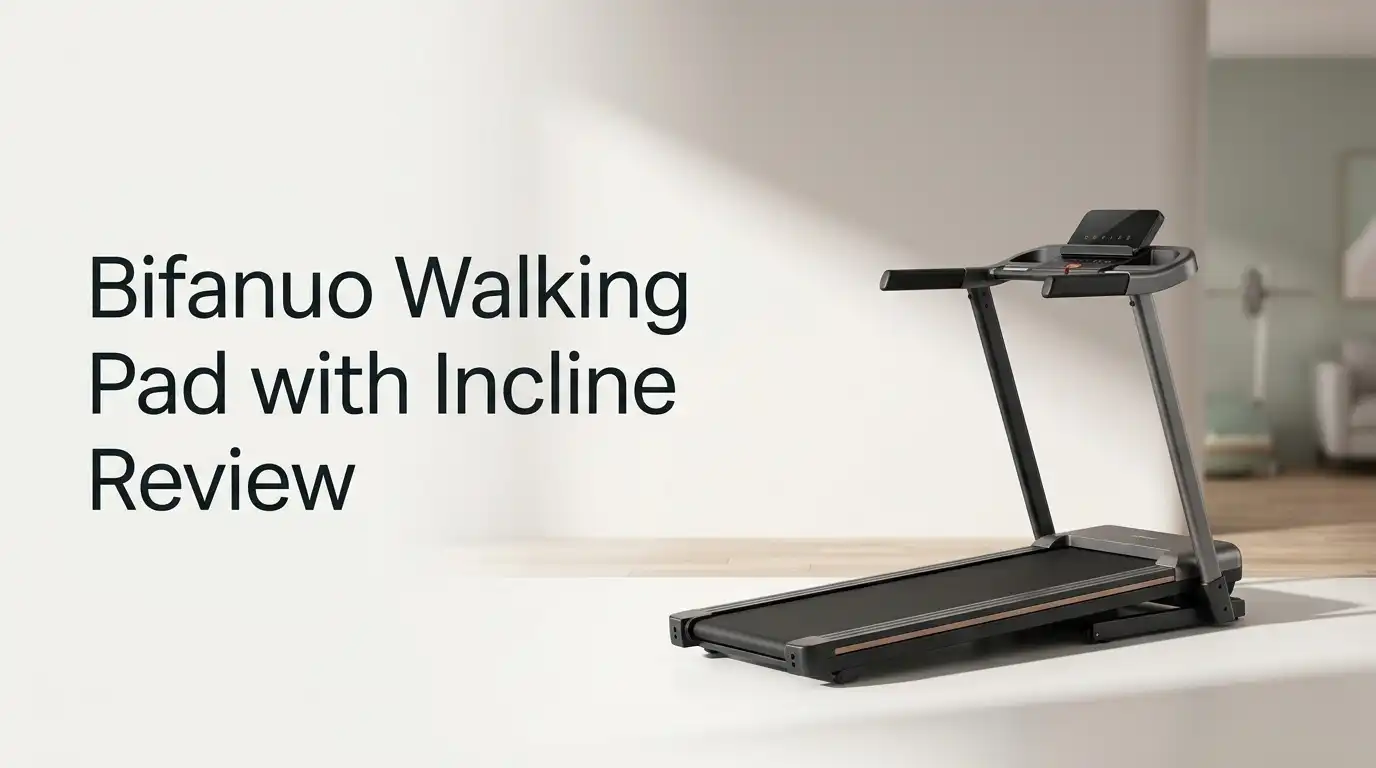
The Bifanuo Walking Pad with Incline is a compact under desk treadmill built for homes and offices with limited floor space. The deck measures roughly 49 inches long and 22 inches wide, with a running surface near 41 by 16 inches.
A brushless motor rated between 2.25 and 2.5 horsepower drives the belt at speeds from 0.6 to 4 mph. The headline feature is the permanent 5 degree deck angle, which raises the front of the pad so every step works your legs harder.
Bifanuo ships the unit fully assembled, which separates it from many budget rivals. You get an LED display, a magnetic safety key, a slim remote, transport wheels, and a silicone oil bottle.
The whole package targets one buyer: the person who sits too long and wants movement without a gym membership.
Unboxing Experience and First Impressions
The box arrives heavy. Mine weighed close to 50 pounds, so grab a friend or use the floor drag method. Inside, the pad sits wrapped in thick foam with cardboard corner guards.
Nothing shifted in transit, which is reassuring given how many walking pads arrive with scratched decks. You pull off the plastic film, snap the safety key onto the console, and plug the cord into a standard wall outlet.
That is the entire setup. The remote ships with a battery already installed in most units. First impression? The pad looks sleeker than the price suggests.
The deck surface has a textured grip pattern. The console sits flush with the frame. The angle is visible immediately, which surprised me because photos undersell how tilted the front really looks.
How the Incline Actually Feels
The incline is fixed, not adjustable. You cannot press a button and flatten it. That sounds like a drawback until you walk on it. The tilt pushes your weight slightly backward, which forces your glutes and calves to engage with every step.
Within fifteen minutes my heart rate sat 8 to 12 beats higher than on a flat pad at the same 2.5 mph pace. The effect compounds over long sessions. A two hour workday walk feels like a real workout rather than a shuffle.
The tradeoff is comfort. Your ankles stay flexed the entire time. People with Achilles tightness or plantar fasciitis may feel strain after the first week. Start with twenty minute blocks and build up slowly.
Top 3 Alternative for Bifanuo Walking Pad with Incline

Last update on 2026-11-10 / Affiliate links / Images from Amazon Product Advertising API
MERACH Walking Pad with Incline 12% Auto Treadmill
No products found.
FOUSAE Walking Pad Treadmill 4 in 1 with 10% Incline


Last update on 2026-11-10 / Affiliate links / Images from Amazon Product Advertising API
Sperax Walking Pad with Incline and Double Frame
Motor Performance and Speed Range
The brushless motor is the quiet hero here. Brushless designs run cooler, last longer, and hum less than brushed motors found in cheaper pads. Bifanuo rates the motor between 2.25 and 2.5 horsepower depending on the model year.
In practice the belt holds a steady pace under a 200 pound walker without stuttering. I never felt the belt hesitate or surge, even during two hour sessions. Speed climbs from 0.6 mph to 4 mph in increments of 0.1 mph, which gives precise control for typing while walking.
The 4 mph ceiling is the honest limit. You can power walk. You cannot jog. If running matters to you, this pad is the wrong purchase and no amount of incline fixes that gap.
Noise Level and Office Friendliness
Noise decides whether a walking pad survives in a shared space. The Bifanuo measures around 45 decibels at 1.5 mph and climbs near 55 decibels at full speed. For reference, 45 decibels sits between a library and a quiet refrigerator.
My partner worked three feet away during testing and never asked me to stop. Video calls work fine below 2.5 mph. Above that, the belt slap becomes audible on sensitive microphones. The motor itself stays almost silent.
Most of the sound comes from your own footfalls hitting the deck. Soft soled shoes cut the noise noticeably. Placing the pad on a thin rubber mat reduces vibration transfer through wooden floors, which matters a lot in apartments with neighbors below.
Belt Size, Cushioning, and Walking Comfort
The walking surface spans roughly 41 inches long by 16 inches wide. That width is average for the category and the length is slightly better than many rivals. Users up to about six feet tall reported comfortable stride room.
Taller walkers will clip the front guard occasionally. The belt uses a five layer construction with a shock absorbing layer underneath. Knees feel noticeably better than walking on concrete.
The cushioning is not plush though. Compare it to a quality pavement sidewalk rather than a padded gym treadmill. The deck surface grips well even with sweaty shoes.
Side rails are narrow, so stepping off mid walk requires care. I recommend keeping a chair or desk edge within arm’s reach for the first few sessions.
LED Display and Remote Control
The console shows four metrics in rotation: speed, time, distance, and calories burned. The LED digits glow bright red and stay readable in daylight. The display sits low on the front guard, which means you look down at a steep angle while standing.
That placement is fine for glances and awkward for constant monitoring. The remote is a slim plastic card with start, stop, speed up, and speed down buttons. It works reliably within about fifteen feet.
The remote is also the weakest link. It is small, easy to misplace, and the plastic feels thin. Several owners report buying replacement remotes within a year. Keep yours in a fixed spot on your desk. There is no smartphone app on most Bifanuo incline models, which feels dated in 2026.
Portability and Storage Options
Bifanuo built this pad for small homes. The folded height sits near 4.3 inches, so it slides under most sofas, beds, and standing desks. Two transport wheels sit at the front edge. You tilt the pad up, roll it to a corner, and stand it against a wall.
The 50 pound weight is the catch. Rolling is easy. Lifting is not. Anyone with back trouble should plan a permanent home for the pad rather than daily relocation. The incline design slightly complicates storage because the deck is not perfectly flat when stowed.
Measure your under sofa clearance before buying. I store mine upright in a closet corner and it disappears completely, which is exactly what a small apartment needs.
Pros and Cons
Every honest review lists both sides. Here is the balance sheet.
Pros
- Arrives fully assembled with no tools required, which saves thirty minutes of frustration.
- The fixed 5 degree incline adds real intensity and burns more calories at identical speeds.
- Brushless motor runs quietly enough for shared offices and video calls below 2.5 mph.
- Slim 4.3 inch profile slides under furniture, and transport wheels make rolling simple.
- Strong price to feature ratio compared to premium brands charging double for similar specs.
Cons
- The incline is fixed and cannot be flattened, which limits versatility for tired days.
- Speed caps near 4 mph, so running is off the table entirely.
- The 265 pound weight limit excludes heavier users who need 350 pound ratings.
- The remote feels cheap and failures within the first year are a common complaint.
- No app connectivity, no Bluetooth audio, and no workout programs on most incline models.
- Printed instructions are vague, especially around belt lubrication intervals.
What This Walking Pad Does Not Do Well
Honesty matters more than hype. Belt tracking drifts on some units. After roughly thirty hours of use, my belt pulled slightly left and needed an Allen key adjustment. The manual covers this poorly. A short video search solved it in five minutes, but a beginner would feel lost.
Customer support responses are slow, often taking three to five business days. Replacement parts beyond the remote are difficult to source. The side rails flex when you plant a foot on them, so never use them as a stepping platform.
The calorie counter overestimates by a wide margin, likely 20 to 30 percent. Treat that number as motivation rather than data. Finally, the power cord is short at roughly five feet, so budget for an extension lead.
Maintenance and Long Term Durability
Walking pads live or die by belt care. Bifanuo includes a small silicone oil bottle for a reason. Lubricate the belt underside every three months or every 100 hours of use, whichever comes first. Skipping this step is the single biggest cause of motor burnout in budget pads.
Wipe the deck weekly with a dry cloth. Vacuum under the machine monthly because dust buildup strains the motor. Check belt tension every few weeks by lifting the center of the belt; roughly two inches of lift is correct.
Owners who follow this routine report two to three years of trouble free use. Owners who ignore it report belt slipping within eight months. The maintenance load is light, but it is not optional.
Who Should Buy This Walking Pad
This machine fits a specific person well. Remote workers who sit six or more hours daily gain the most value. The incline turns passive standing into genuine cardio without eating your workday. Apartment dwellers benefit from the slim profile and low noise.
Beginners returning to exercise will find 2 mph on an incline challenging enough to feel worthwhile. Budget conscious buyers get strong hardware for the money.
Skip this pad if you weigh more than 265 pounds, if you want to run, if you need adjustable incline settings, or if app tracking drives your motivation. Athletes training for races should buy a full treadmill instead. The Bifanuo serves the daily step counter, not the marathon runner.
Price and Value Verdict in 2026
Pricing hovers between 150 and 250 dollars depending on sales cycles and coupon stacks. At that range the value proposition is strong. Comparable incline pads from MERACH and Sperax cost 50 to 150 dollars more while offering auto incline and app features.
The question is whether you need those extras. Many buyers do not. A fixed incline removes a moving part that can break. Fewer features often mean fewer failure points.
The best buying windows land around Prime Day, Black Friday, and January fitness sales, where discounts of 30 to 40 percent appear regularly. Paying full list price is unnecessary. Set a price alert and wait two weeks if you can.
Final Verdict on the Bifanuo Walking Pad with Incline

Last update on 2026-11-10 / Affiliate links / Images from Amazon Product Advertising API
The Bifanuo Walking Pad with Incline earns a solid recommendation with clear boundaries. It delivers more calorie burn, quiet operation, and zero assembly for a fair price.
The fixed incline is the standout feature and the main reason to choose this over a flat pad. You trade away running speed, adjustability, app connectivity, and a higher weight ceiling. For a desk worker who wants 8,000 steps without leaving the house, those trades are easy.
My score sits at 4 out of 5. Points come off for the flimsy remote, the vague manual, and the inflated calorie readout. If you walk daily, lubricate the belt, and keep expectations realistic, this pad will serve you well into 2027 and beyond.
Frequently Asked Questions
Can you adjust the incline on the Bifanuo walking pad?
No. The incline is fixed at approximately 5 degrees on this model. The deck arrives tilted and stays tilted. You cannot flatten it or raise it further. Buyers who want variable angles should look at auto incline models from MERACH or FOUSAE instead.
How many calories does the incline add per hour?
Most users burn an extra 150 to 200 calories per hour compared to a flat pad at the same speed. Your actual number depends on body weight, pace, and session length. Note that the onboard calorie display tends to read high, so treat it as a rough guide.
Is the Bifanuo walking pad quiet enough for video calls?
Yes, below 2.5 mph. At that pace the machine measures around 45 to 50 decibels, quiet enough that microphones rarely pick it up. Above 3 mph your footfalls become audible to callers. A rubber mat underneath reduces vibration noise further.
What is the maximum user weight?
The rated capacity is 265 pounds on most Bifanuo incline models. Some newer units advertise 300 or 350 pounds, so check the specific listing before ordering. Exceeding the rating voids the warranty and strains the motor.
Do you need to assemble the Bifanuo walking pad?
No assembly is required. The pad ships fully built. You remove the packaging, insert the safety key, plug it in, and start walking. Total setup time runs under five minutes for most buyers.
How often should you lubricate the belt?
Apply silicone oil every three months or every 100 hours of walking, whichever arrives first. The unit includes a starter bottle. Skipping lubrication is the leading cause of early belt and motor failure in this price category.

Hi, I’m Sarah Hill — the founder and voice behind Heavy Lift Vault. I’m passionate about fitness, strength training, and health technology. I spend my time researching, testing, and reviewing workout equipment and health devices so you don’t have to guess. My goal is to deliver honest, detailed, and trustworthy reviews that help you invest wisely in your fitness journey.