NeoSilent Walking Pad Review 2026: Worth Buying?
Walking pads went from a quirky gadget to a desk staple in just a few years. The NeoSilent Walking Pad sits right in the middle of that wave. It promises a quiet brushless motor, an extra large belt, and a 9% incline that most budget pads skip.
That combination sounds great on paper. The real question is whether it holds up after weeks of daily use under a real desk with real deadlines.
This review covers the unboxing, the build, the app, the noise, the incline, and the flaws. You will also see three solid alternatives in case this pad does not match your setup. Keep reading before you spend your money.
In a Nutshell:
- The motor lives up to the name. The 2.5 horsepower brushless core runs quietly at walking speeds. Colleagues on video calls did not hear it. The belt hum stays below normal conversation level at 2 mph.
- The incline is the standout feature. Four fixed levels reach 9%. That single feature pushes your heart rate up and burns noticeably more calories than flat walking, and very few pads in this price band offer it.
- The belt is genuinely wide for this category. At 40 inches long and 16 inches across, it fits a natural stride better than the narrow 14 inch pads. Tall users still need to watch their stride length.
- It is a walker, not a runner. Top speed sits at 4 mph. That is brisk walking territory. Anyone wanting to jog should look elsewhere.
- Weight and storage need planning. The unit weighs around 42 pounds. The wheels help, but lifting it over a door threshold is a two hand job.
- Value depends heavily on the sale price. At street prices it competes well. At full list price, cheaper pads deliver 80% of the experience.
What Is the NeoSilent Walking Pad?

Last update on 2026-10-30 / Affiliate links / Images from Amazon Product Advertising API
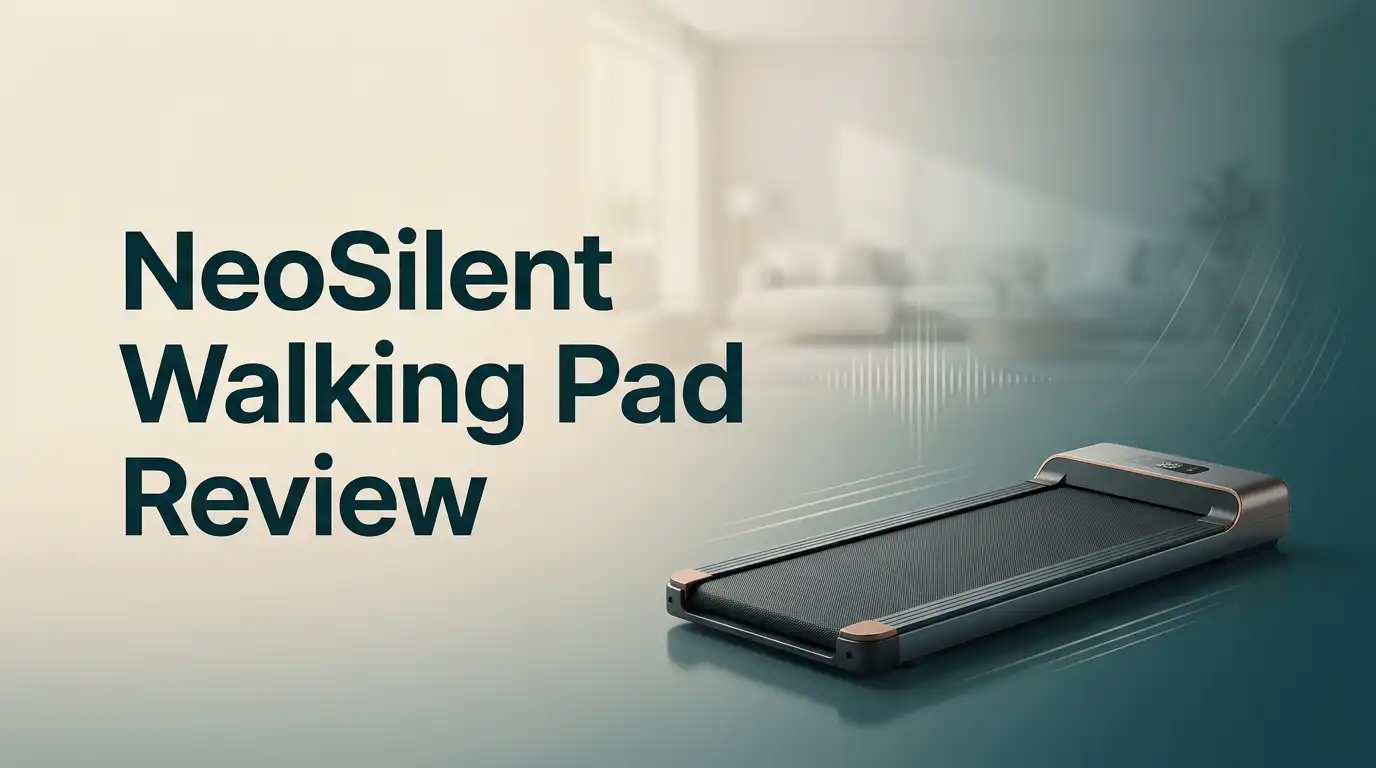
The NeoSilent Walking Pad is a flat, frameless treadmill built by Hartwares for desk use and small apartments. It has no handrail and no console tower. The entire machine stands about three inches tall, so it slides under a sofa or bed when you finish.
The headline specs are straightforward. A 2.5 horsepower brushless motor drives the belt. Speed runs from 0.6 mph to 4 mph. The deck measures 40 inches by 16 inches. Maximum user weight is 265 pounds. The incline system offers four settings at 2%, 5%, 7%, and 9%.
You control everything with a remote or a phone app. An LED display sits at the front of the deck and shows time, distance, steps, speed, and calories. It arrives fully assembled, which removes the usual treadmill headache of bolts and brackets.
Unboxing Experience
The box is big and heavy. Mine arrived at roughly 50 inches long and tipped the scale near 42 pounds for the unit itself. Plan a clear path from your front door to the room where it will live.
Inside, the pad sits between thick foam end caps with a plastic sleeve over the belt. Nothing shifted in transit. Under the deck you get a small accessory pouch holding the remote, two batteries, a silicone lubricant bottle, an L shaped wrench, and the manual.
Setup took under four minutes. I slid the pad out, placed it on flat flooring, plugged the cord into a grounded outlet, and flipped the power switch at the front. The display lit up instantly. The remote paired with no setup at all since it uses infrared.
One honest note: the belt smelled faintly of rubber and machine oil for the first two days. Air out the room. The smell faded completely by day three.
Design and Build Quality
The deck wears an ink black finish that hides dust reasonably well. The frame is alloy steel, and it feels solid when you step on the middle of the belt. There is no sponginess or creak under a 180 pound user.
The belt itself uses a five layer construction with cushioning elastomers under the deck. Knees notice the difference. After an hour of walking, my joints felt better than they do on hard flooring or on a cheap pad with a thin board.
The side rails are narrow, which is normal for this category. They give you a small landing strip for stepping off, nothing more. The LED panel is bright but fixed, so you read it by looking down between your feet.
The visual design is plain and quiet, which is exactly right for something that lives under a desk. It does not shout for attention.
Top 3 Alternative for NeoSilent Walking Pad


Last update on 2026-10-30 / Affiliate links / Images from Amazon Product Advertising API
UREVO Smart Walking Pad

Last update on 2026-10-29 / Affiliate links / Images from Amazon Product Advertising API
Goplus 2 in 1 Folding Treadmill

Last update on 2026-10-30 / Affiliate links / Images from Amazon Product Advertising API
WalkingPad A1 Pro Folding Treadmill
Motor Power and Noise Levels
The brand name sets a high bar, and the motor mostly clears it. Brushless motors skip the carbon brushes found in cheap pads, so there is less friction, less heat, and less grinding noise over time.
At 1.5 to 2 mph the pad produces a low, even hum. I measured it subjectively against my refrigerator and the fridge was louder. Nobody on my video calls ever asked what the sound was. Push the speed to 3.5 mph and you hear more, mostly from your own footfalls rather than the motor.
The manufacturer claims eight hours of continuous operation. I ran it in four hour blocks without any heat smell or slowdown. The motor never tripped or stuttered.
One caveat matters. Noise depends on your floor. On bare tile, footstep sound bounces around the room. A thin treadmill mat solved that problem for me completely.
The 9% Incline Feature
This is the reason to pick this pad over a flat one. The incline uses four fixed positions rather than a smooth motorized ramp, so you select 2%, 5%, 7%, or 9% and the deck sets itself.
The difference in effort is real. At 2 mph on flat ground I barely register a workout. At 2 mph on 9%, my calves and glutes wake up and my heart rate climbs by 20 or more beats per minute. You burn far more calories at the same speed.
The trade off is typing comfort. At 9% your body leans forward slightly and your arms shift position. I found 5% to be the sweet spot for walking and working at the same time. I save 9% for calls where I am only listening.
The incline change is not instant. Expect several seconds of adjustment.
Belt Size and Walking Comfort
A 40 by 16 inch belt is wide for a walking pad. Many competitors sit at 14 inches across, which forces you to walk a tightrope. The extra two inches here let your feet land naturally without clipping the rails.
Length is the bigger limitation. Forty inches suits users up to about six feet tall at walking speeds. I am five foot ten and had comfortable room at 2 to 3 mph. At 3.5 mph my stride lengthened and I had to shorten it deliberately.
The cushioning deserves praise. The dual TPR layer absorbs impact better than the rigid boards in entry level pads. My shins stayed quiet after long sessions, which was not true of a cheaper pad I tested last year.
Users over six foot two should look at a longer deck.
App and Remote Control
The remote is the tool you will actually use. It handles power, speed up, speed down, and display mode. It is small, light, and easy to lose, so clip it to your desk edge.
The companion app connects over Bluetooth. It tracks steps, distance, time, and calories, and it offers guided walking programs and scenic trail modes. The data syncing works, but the interface feels dated. Buttons are small and the translation is rough in places.
Pairing dropped twice during my testing, and I had to toggle Bluetooth to reconnect. The pad keeps running when the app disconnects, so nothing gets dangerous. You simply lose that session’s data.
If app features matter deeply to you, this is the weakest part of the package. If you only want speed control and a step count, the remote covers everything.
Performance During Work Hours
The practical test is whether you can type while walking. The answer is yes, with limits. At 1.2 to 2 mph my typing accuracy stayed normal and my mouse work was fine.
Above 2.5 mph, precision tasks suffer. Clicking small targets in a spreadsheet becomes annoying. Reading and listening work at any speed. Writing works up to roughly 2.2 mph for most people.
I averaged four to five extra miles per workday without changing my schedule. That is the real benefit of a pad like this. The steps come free while you answer email.
Heat was never an issue. The deck stayed cool to the touch after multi hour sessions. The belt tracked straight for the first three weeks, then drifted slightly left and needed one quarter turn on the tension bolt to recenter.
Portability and Storage
Two transport wheels sit at the front edge. Tilt the pad up, grab the back end, and roll it like a suitcase. On hard floors this works smoothly. On thick carpet it does not.
At 42 pounds, the pad is heavier than the lightest options but lighter than folding models with handrails. Lifting it up a flight of stairs alone is awkward. Two people make it easy.
The three inch profile is the selling point. It slides under most beds and under sofas with decent clearance. Measure your gap before buying, since a very low couch will not clear it.
There is no folding mechanism and no carry handle. Those two omissions are felt. A recessed grip on the rear edge would have made storage much nicer.
What the NeoSilent Does Not Do Well
Honest reviews name the weak spots, so here they are plainly.
It cannot run. Four miles per hour is the ceiling. Treat it as a walking tool only.
The app is mediocre. Connection drops, clunky menus, and limited export options. It does not sync natively with major fitness platforms in a clean way.
The display is hard to read mid stride. It sits low and shows one metric set at a time. You look down to check anything.
Incline is stepped, not continuous. You cannot fine tune to 4% or 6%.
Long term durability is an open question. This model first appeared in late 2025, so there is no multi year ownership data yet. Walking pads as a category have a reputation for motor and board failures in year two or three. The one year warranty is standard but short.
Belt alignment needs occasional attention. Expect to use the wrench.
Pros and Cons
Here is the balance sheet in plain terms.
Pros
- Genuinely quiet brushless motor that handles long sessions without heat buildup
- Four level incline up to 9%, rare at this price point
- Extra wide 40 by 16 inch belt with real cushioning
- Zero assembly, running within five minutes of opening the box
- Slim three inch profile that stores under furniture
- Supports up to 265 pounds, above many budget rivals
- Remote and app dual control with a readable LED panel
Cons
- Top speed of 4 mph rules out jogging entirely
- App connection drops and the interface feels unpolished
- Deck length is tight for users above six foot two
- No folding frame and no carry handle
- Incline adjusts in fixed steps, not smoothly
- Only a one year warranty with limited track record
- Belt requires periodic tensioning and lubrication
Who Should Buy It
This pad fits a specific person well. You work from home or in a private office. You sit too much. You want steps during meetings and email blocks rather than a cardio session.
It suits apartment dwellers especially. The quiet motor and low profile solve the two problems small spaces create. Downstairs neighbors stay happy at walking speeds.
It also suits anyone who wants more intensity without more speed. The incline lets you raise effort while keeping your feet under control for typing.
Skip it if you want a jogging treadmill, if you are taller than six foot two, or if deep app integration with your fitness ecosystem matters. Also skip it if you need to move the pad between rooms daily, since 42 pounds with no handle gets old fast.
Price and Value in 2026
List pricing on this model has swung wildly, from several hundred dollars down to deep discount territory during sale events. Your verdict should track the price you actually pay.
Around the two hundred dollar mark, this pad is a strong buy. You get incline, a wide belt, and a brushless motor, which is a feature set usually reserved for higher tiers.
Near four hundred dollars, the math changes. At that level you start comparing against models with longer decks, better apps, and longer warranties.
My advice is simple. Watch the price, set an alert, and buy during a sale. The hardware deserves a good price but not a premium one, mainly because the software and the warranty lag behind the mechanics.
Maintenance Tips for Longer Life
A little care doubles the life of any walking pad. Lubricate the belt before first use and every three to six months after that, using the silicone oil included in the box. Apply it under the belt at the center of the deck, then run at 0.6 mph for five minutes.
Check belt alignment monthly. If the belt drifts, turn the rear tension bolt one quarter turn on the side it drifts away from, then test.
Wipe the deck and belt with a damp cloth weekly. Dust and sweat grind down the surface over time. Never use harsh cleaners.
Unplug it when not in use. Keep it on flat flooring, since an uneven surface twists the frame. Finally, respect the weight limit. Overloading the motor is the fastest route to failure.
Final Verdict
Last update on 2026-10-30 / Affiliate links / Images from Amazon Product Advertising API
The NeoSilent Walking Pad does the main job very well. It is quiet, it is comfortable, and the incline adds real value that most rivals cannot match. For desk walking, it is an easy recommendation at sale pricing.
The flaws are honest ones rather than dealbreakers. The app underwhelms, the deck is short for tall users, and the warranty is thin. None of that stops it from adding four or five miles to your day.
Buy it if you want steps while you work. Look elsewhere if you want to run, or if you need a long deck for a tall stride. For everyone in between, this pad earns its place under the desk.
Frequently Asked Questions
Is the NeoSilent Walking Pad actually quiet?
Yes, at walking speeds. The brushless motor produces a low hum that stays below normal conversation volume. Your footsteps generate more sound than the machine. A treadmill mat reduces floor noise further, which matters most in apartments.
Can you run on this walking pad?
No. The top speed is 4 mph, which is a brisk walk or a very slow shuffle. The deck is also 40 inches long, which is too short for a safe running stride. Choose a full treadmill if you plan to run.
How tall can you be and still use it comfortably?
Users up to about six feet tall fit comfortably at 2 to 3 mph. Between six foot and six foot two it works with a shortened stride. Above that height, the 40 inch deck feels cramped and you risk clipping the rear roller.
Does the incline really make a difference?
Yes. Walking at 9% incline raises heart rate significantly compared with flat walking at the same speed. Expect a noticeable calorie difference. The trade off is that typing becomes harder at the steepest setting.
Do you need the app to use it?
No. The remote handles power, speed, and display modes on its own. The app only adds tracking, programs, and trail modes. Many owners ignore the app entirely and lose nothing important.
How often does the belt need lubrication?
Every three to six months with moderate daily use. Heavy users should check sooner. Silicone lubricant comes in the box, and applying it takes about five minutes.
Will it work on carpet?
It runs on low pile carpet without trouble. Thick carpet traps heat under the motor housing and makes the wheels useless for moving it. A hard board or mat underneath solves both issues.

Hi, I’m Sarah Hill — the founder and voice behind Heavy Lift Vault. I’m passionate about fitness, strength training, and health technology. I spend my time researching, testing, and reviewing workout equipment and health devices so you don’t have to guess. My goal is to deliver honest, detailed, and trustworthy reviews that help you invest wisely in your fitness journey.