
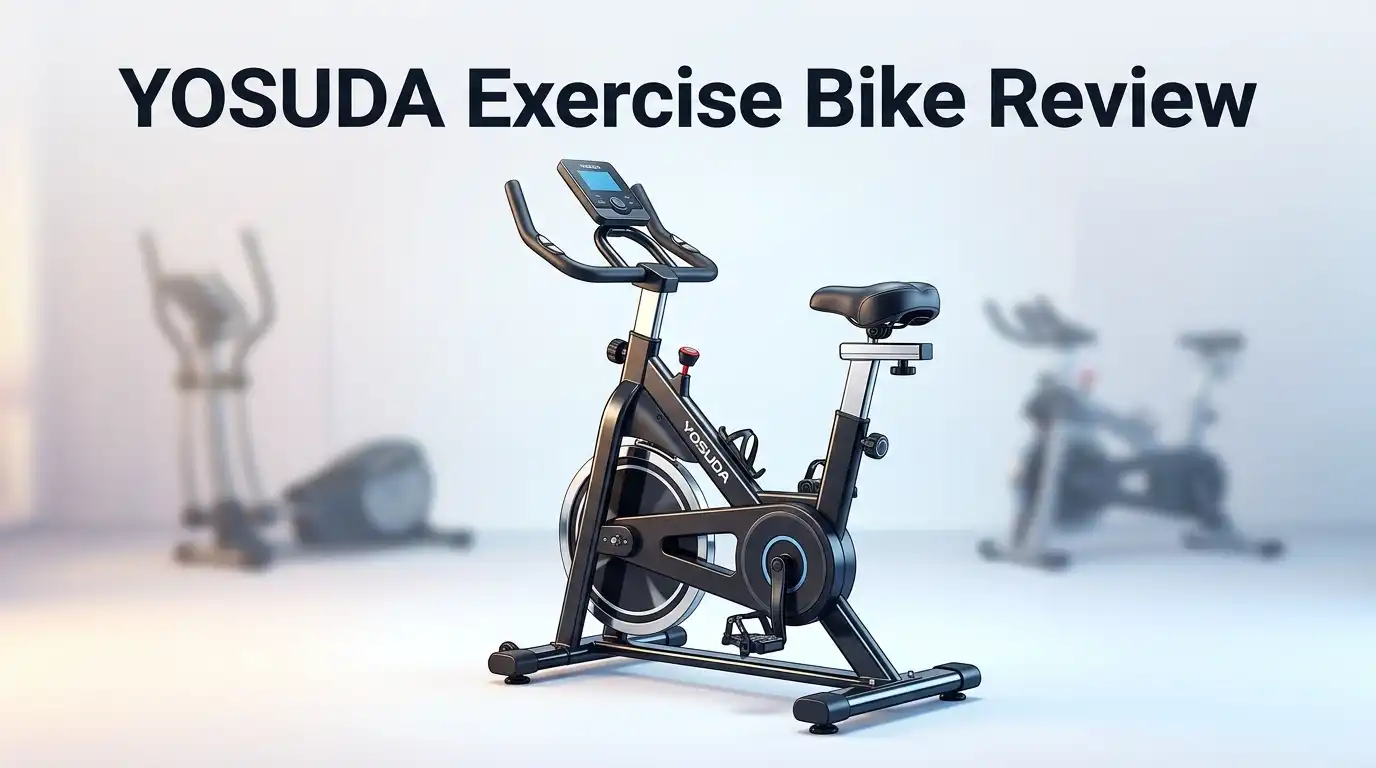
YOSUDA Exercise Bike Review 2026: Worth It?
The YOSUDA exercise bike sits near the top of Amazon’s exercise bike charts almost every month. It carries more than 25,000 ratings and a 4.4 star average. It also costs a fraction of a Peloton. That combination makes people curious and a little suspicious at the same time.
I spent weeks riding this bike, timing the assembly, checking the noise with sleeping housemates, and watching for the wear that long term owners keep reporting.
This review covers the good rides and the cheap plastic. You will read what the bike nails, what it fumbles, and whether your money belongs here in 2026.
In A Nutshell:
- The price is the headline. The standard YOSUDA magnetic bike runs around $260, and the PRO model sits near $400. Most upright studio bikes start at $600. You get a steel frame, a weighted flywheel, and a real workout for entry level money.
- Magnetic resistance makes it quiet. YOSUDA rates the newer magnetic models near 20dB. I rode it at 6 a.m. in a small apartment and nobody woke up. Older friction models make a soft whooshing sound instead.
- Durability is the weak spot. Reviewers report seat tears, loose pedal clasps, and flywheel noise after a few months. My test unit showed a small seat tear early. This is the main reason the bike scores low with gear testers.
- The tech is basic. You get an LCD monitor that tracks time, speed, distance, and calories. Newer models add Bluetooth and an app. There is no built in screen and no automatic resistance.
- Setup is genuinely easy. The bike arrives about 80 percent assembled. I finished in 28 minutes with the included tools.
- Best for beginners and small rooms. Serious cyclists and heavy daily users should save for something sturdier.
YOSUDA Exercise Bike Review 2026: The Full Picture

Last update on 2026-10-17 / Affiliate links / Images from Amazon Product Advertising API
The YOSUDA Exercise Bike is an upright indoor cycling bike built for home use. It mimics the posture of a studio spin bike. You lean forward, your weight splits between the saddle and the multi grip handlebars, and you pedal against a weighted flywheel.
YOSUDA launched in 2018 and operates under FED Fitness. The bikes are manufactured in China and shipped from United States warehouses. The brand now lists around eleven bike models, from folding X bikes near $140 to the PRO Max near $500.
The current flagship magnetic model carries a 300 pound weight capacity, a balanced flywheel, and a belt drive system. It fits riders roughly between 4 feet 8 inches and 6 feet 2 inches. My tallest tester stands 6 feet 3 inches and still found a workable seat height, though he sat near the limit.
What makes this bike sell so well is not engineering. It is accessibility. You order it on Prime, build it in half an hour, prop a tablet on the holder, and stream a class. No membership. No subscription lock. No four figure invoice.
The catch arrives later. This bike is built to a price, and every part reflects that choice. I will break down exactly where the savings show up.
Unboxing Experience: What Arrives At Your Door
The box shows up heavy and dense. Mine weighed close to 80 pounds with packaging. Do not try to lift it alone. I slid the box along the floor to the room, then cut it open flat and lifted parts out one at a time.
Inside, the frame sits in molded foam with the flywheel already attached and covered. That single detail saves you the worst part of any bike build. The flywheel, crank, and resistance system come preassembled as one unit.
The loose parts sit in a small cardboard tray: front and rear stabilizers, seat post, saddle, handlebar post, handlebars, pedals, the LCD monitor, and a hardware bag. YOSUDA includes an Allen key, a small wrench, and two AA batteries. You do not need your own tools.
My first reaction was mixed. The frame felt reassuringly solid and the paint looked clean with no chips. The accessories told a different story. The tablet holder is thin plastic, the monitor housing feels hollow, and the water bottle cage flexes when you squeeze it.
The manual is simple and uses clear diagrams. A QR code links to an assembly video. Check every part against the parts list before you start. Missing hardware is one of the most common complaints in Amazon reviews, and catching it early saves a week of waiting.
Assembly Time: How Hard Is The Build
I timed my build at 28 minutes working alone. YOSUDA claims setup takes under 30 minutes, and that estimate holds up for anyone who has assembled flat pack furniture.
The order is logical. Bolt on the rear stabilizer, then the front stabilizer with the transport wheels. Slide in the seat post and saddle. Attach the handlebar post and handlebars. Thread the pedals. Clip on the monitor and connect the single sensor cable.
Two steps deserve attention. First, the pedals thread in opposite directions. The left pedal tightens counterclockwise. Force it the wrong way and you strip the crank thread, which is a common and avoidable failure.
Second, tighten every bolt in stages rather than fully locking each one as you go. The frame settles slightly, and a final pass keeps the bike from developing a wobble a week later.
The monitor mount is the fiddliest part. It attaches with a thin plastic bracket that never feels fully seated. I tightened mine twice and it still shifts when bumped.
Once built, drop the bike on a mat. Carpet is the enemy here. Several owners report rocking on soft flooring, and a rubber mat fixes most of that instability while protecting your floor from sweat.
Top 3 Alternative for YOSUDA Exercise Bike


Last update on 2026-10-17 / Affiliate links / Images from Amazon Product Advertising API
Schwinn Fitness IC4 Indoor Cycling Bike

Last update on 2026-10-17 / Affiliate links / Images from Amazon Product Advertising API
Sunny Health & Fitness Magnetic Belt Drive Indoor Cycling Bike SF B1805

Last update on 2026-10-17 / Affiliate links / Images from Amazon Product Advertising API
Sunny Health & Fitness Indoor Cycling Exercise Bike SF B1002
YOSUDA Bike Specifications Explained Simply
Specs sheets hide meaning behind numbers. Here is what the YOSUDA figures actually mean for your ride.
Footprint: roughly 40 inches long by 22 inches wide. That works out near 6.1 square feet, or about half the floor space of a loveseat. The bike fits in a bedroom corner or a studio apartment without dominating the room.
Flywheel: YOSUDA uses 25 pound, 35 pound, and 40 pound flywheels across the lineup. Heavier flywheels carry more momentum, which smooths your pedal stroke and mimics road riding. Lighter flywheels feel easier to spin and gentler on the knees.
Resistance: the newer magnetic models offer around 100 micro adjustable levels through a knob. Older friction models press a felt brake pad against the flywheel. Magnetic runs quieter and needs no pad replacement.
Drive system: belt drive on every model. A belt runs quieter than a chain and needs no oiling. It also wears out eventually and cannot be tightened forever.
Weight capacity: 270 to 350 pounds depending on model. The PRO tops the range at 350 pounds with thicker steel tubing.
Bike weight: 68 to 90 pounds. Lighter models roll easily on the front transport wheels. The 90 pound PRO is a two person move.
Adjustability: four way saddle and two way handlebars on most models, with an inseam range near 25 to 35 inches.
Ride Feel And Resistance Performance
This is where the YOSUDA surprises people. The ride quality punches above the price. The flywheel spins with real momentum, and the belt drive stays smooth through cadence changes.
Resistance adjusts through a knob under the handlebar post. Turn clockwise for harder, counterclockwise for easier. The magnetic system engages progressively, with no grabbing or sudden jumps.
At maximum resistance, the bike gets genuinely hard. I stood up for climbing intervals and my legs gave out before the bike did. You will not outgrow the resistance range unless you race competitively.
The frame handles sprints better than I expected. I hit high cadence efforts out of the saddle and felt only mild side to side sway. On a rubber mat over hardwood, the bike stayed planted.
Here is the main complaint. The resistance knob has no numbered markings. You cannot repeat yesterday’s level, and you cannot follow a class instruction like level seven. You adjust entirely by feel.
That hurts structured training. Interval workouts and app based classes assume repeatable resistance. With the YOSUDA, you guess. Some owners fix this with a paint pen mark on the knob, which is a clever workaround for a design gap that should not exist.
Braking works through the same knob. Push it down and the bike stops fast, which matters for safety.
Noise Level: Can You Ride At Midnight
Noise decides whether a home bike gets used or ignored. A loud bike sits in the corner because you feel guilty riding it.
The magnetic YOSUDA models pass this test. YOSUDA rates them near 20dB, which sits close to a whisper. Magnets never touch the flywheel, so the only sound comes from the belt and the bearings.
In my testing, the loudest sound was my own breathing. I rode while someone slept behind a closed door in a small apartment. No complaints and no wake ups.
The friction models tell a different story. A felt brake pad rubs the flywheel, and that produces a soft whooshing sound that rises with resistance. It is not harsh, but it is clearly audible in a quiet room.
One warning from long term owners. Several report a grinding or clicking noise developing after a few months. The usual causes are a loosening crank bolt, a dry bearing, or a belt losing tension. A quarterly bolt check prevents most of it.
If you live in an upstairs apartment, add a thick mat. The bike is quiet, but vibration still travels through floors during hard sprints.
Seat Comfort And Adjustability Reality Check
The saddle is the most divisive part of this bike, and honesty matters here.
YOSUDA advertises high density memory foam with a pressure relief channel. For the first two weeks, it feels fine. I rode 30 minute sessions with no discomfort and thought the complaints were exaggerated.
Then the foam compressed. By week three, the saddle felt firmer and less forgiving on longer rides. This matches a pattern across hundreds of owner reviews.
Worse, a small tear appeared in my seat cover after only a handful of rides. Other testers report the same thing. The stitching and vinyl simply are not durable.
The good news is that the saddle uses a standard rail mount. You can swap it for a gel saddle or a wide comfort saddle for around $30. Many owners do this immediately and call it the single best upgrade.
Adjustability itself is solid. The saddle moves up, down, forward, and back. The handlebars move up and down. Pop pins lock into fixed holes, which is quick but limits fine tuning between positions.
Riders around 5 feet 2 inches to 6 feet find a workable fit. Riders under 5 feet may find the lowest saddle position still slightly high, and very tall riders will max out the post.
The Monitor And App Experience
The LCD monitor is small, simple, and battery powered. It tracks time, speed, distance, calories, and a total odometer. One button cycles through the metrics and turns the unit on.
Accuracy is approximate, not scientific. Calorie counts on any bike without a power meter are estimates based on wheel speed. Treat the number as motivation, not data.
Newer YOSUDA models add Bluetooth and an exclusive app with guided sessions and progress tracking. That is a real improvement over older units, which had no connectivity at all.
Two limits still apply. First, the app ecosystem is small compared to established platforms. Second, there is no automatic resistance control. Apps can tell you to increase resistance, but the bike will never do it for you.
The PRO model adds a backlit monitor, which solves a genuine annoyance. Non backlit screens are hard to read in a dim basement or early morning room.
The tablet holder deserves a warning. It holds an iPad adequately for streaming. It is not sturdy enough to type on while riding, and mine wobbled with a large tablet. The plastic bracket is one of the cheapest components on the whole bike.
You can stream Peloton, Zwift, or YouTube classes on your own device. You just cannot sync the bike to them.
YOSUDA PRO Magnetic Exercise Bike: The Step Up

Last update on 2026-10-17 / Affiliate links / Images from Amazon Product Advertising API
The PRO model costs roughly $140 more than the standard bike, and the upgrade list is meaningful for some riders.
Weight capacity jumps to 350 pounds. The frame uses thicker commercial grade steel tubing, and you feel that difference during out of the saddle efforts. The bike simply does not flex as much.
The flywheel runs heavier at 35 pounds, paired with 100 micro adjustable magnetic resistance levels. Momentum feels smoother and more road like through the pedal stroke.
Three quality of life features stand out. The monitor is backlit, so you can read your stats in low light. Bluetooth connects to compatible fitness apps. The tablet holder pivots and extends up to 11 inches, which finally puts your screen at eye level.
The seat cushion is thicker and more supportive than the base model, though it still is not a premium saddle.
Now the downsides. The PRO weighs about 90 pounds. Transport wheels help, but moving it upstairs or across rooms needs two people. It also takes slightly more floor space.
Its rating sits at 4.3 stars, marginally below the base model. Reviewers mention sharp edges on some handlebar extensions and the usual budget assembly inconsistencies.
Choose the PRO if you weigh over 270 pounds, ride four or more times weekly, or want to train in a dark room. Otherwise the base model delivers most of the experience for less.
What The YOSUDA Bike Does Not Do Well
Authentic reviews name the failures. Here are the YOSUDA weaknesses without softening.
Long term durability is poor. Gear testers score this bike around 2.5 out of 5 for durability. Hundreds of Amazon reviews describe parts failing within two to six months. Pedals loosening or snapping is the most reported problem, followed by flywheel noise and seat wear.
Small parts feel cheap. The monitor bracket, tablet holder, and bottle cage are thin plastic. They function, but they do not inspire confidence and they break first.
No resistance markings. You cannot repeat a workout precisely or follow class instructions. For structured training, this is a real handicap.
No screen and no automatic resistance. You supply your own tablet and you turn your own knob. There are no preloaded programs on the bike itself.
Quality control varies. Missing bolts, missing tools, and shipping damage appear regularly in reviews. Inspect your box the day it arrives, not a month later.
Pedals cannot be swapped easily. Removing them requires replacing the whole crank on many models. Clipless pedal users will find this frustrating.
The saddle degrades. Budget on $30 for a replacement.
To YOSUDA’s credit, customer service responds quickly and ships free replacement parts within the warranty window. Many one star reviews get updated to three or four stars after support steps in.
Pros And Cons Summary
Pros
- Outstanding value at around $260. You get a steel frame, weighted flywheel, and belt drive for roughly a third of a studio bike price.
- Very quiet magnetic resistance rated near 20dB. Early morning and late night rides will not wake the house.
- Compact footprint near 6.1 square feet, with front transport wheels for easy repositioning.
- Fast assembly at roughly 30 minutes, with all tools and batteries included in the box.
- Genuinely hard at maximum resistance. You will not outgrow the range as a casual or intermediate rider.
- Responsive customer service with free replacement parts inside the warranty period.
- Four way saddle and two way handlebar adjustment fits most riders between 5 feet and 6 feet 2 inches.
Cons
- Weak long term durability. Seat tears, pedal failures, and flywheel noise appear within months for many owners.
- No resistance level markings, which makes repeatable training and app based classes difficult.
- Flimsy accessories. The tablet holder, monitor bracket, and bottle cage are thin plastic.
- No built in screen and no automatic resistance control.
- Inconsistent quality control, including missing hardware and shipping damage.
- The saddle needs replacing for most riders doing sessions longer than 30 minutes.
- The PRO model weighs about 90 pounds, which makes solo moves difficult.
Who Should Buy It And Who Should Skip It
Buy the YOSUDA if you are a beginner. You want to start cycling without gambling $1,500 on a habit you have not built yet. This bike lets you test the commitment cheaply.
Buy it if space is tight. At about 6 square feet with transport wheels, it slides into a corner and rolls out when needed. Apartment dwellers benefit most.
Buy it if quiet matters. The magnetic models are among the quietest bikes at any price. Shared walls and sleeping children are not a problem.
Buy it if you already own a tablet. Prop your iPad on the holder, stream a class, and you have a workable studio setup for under $300.
Skip it if you are a serious cyclist. You need power measurement, repeatable resistance, and a frame built for daily punishment. None of that lives here.
Skip it if you want one purchase to last a decade. Realistic expectations put this bike at one to three years of moderate use. Spend $700 to $900 on a Schwinn IC4 instead.
Skip it if you weigh near the capacity limit. Choose the 350 pound PRO model rather than pushing a 270 pound frame.
Skip it if you hate assembly and tinkering. This bike needs occasional bolt tightening. Owners who maintain it get far better results than those who ignore it.
Maintenance, Warranty, And Customer Service
A little maintenance changes the lifespan of this bike dramatically. Most reported failures trace back to neglect rather than pure defect.
Check every bolt monthly. The crank bolts, pedal threads, and stabilizer bolts loosen with vibration. Five minutes with the included Allen key prevents the grinding noise that fills negative reviews.
Wipe sweat off after every ride. Sweat corrodes the frame near the handlebar post and the seat post. A towel and a dry cloth solve this.
Keep the flywheel area clean. Dust and hair collect around the magnets and bearings. A vacuum pass every few weeks helps.
Do not lubricate the belt. Belts run dry. Oil attracts grit and accelerates wear.
On warranty, YOSUDA coverage varies by model and listing. Older Amazon listings showed three months on the frame and one year on parts. Current brand listings advertise up to three years on the frame. Read your specific listing before buying, because the terms differ.
Returns run through Amazon’s standard 30 day window on most listings. Some YOSUDA direct purchases include a 30 day money back guarantee and financing options.
Customer service is a genuine strength. You reach the company by email or phone, and responses typically land within 24 hours. Free replacement parts arrive without much argument, which is why so many frustrated buyers end up satisfied.
Final Verdict: Is The YOSUDA Bike Worth It In 2026
The YOSUDA exercise bike earns its popularity honestly and earns its criticism honestly too.
For roughly $260, the ride experience is excellent. The flywheel feels smooth, the magnetic resistance runs whisper quiet, the frame stays stable during sprints, and setup takes half an hour. Pair it with a tablet and you have a functional home studio for less than three months of gym membership.
The bike falls apart faster than it should. Seats tear, pedals loosen, plastic accessories wobble, and small failures accumulate. Expect one to three years of moderate use, not a decade. Budget $30 for a better saddle and plan on monthly bolt checks.
My rating lands at 3.5 out of 5. That score reflects strong value and a weak build in equal measure.
Buy it if you are starting out, working with limited space, or testing whether indoor cycling fits your life. It is the lowest risk entry into home cycling available right now.
Step up to the PRO model if you weigh more than 270 pounds or ride most days. Step all the way up to a Schwinn IC4 if you want repeatable resistance, app connectivity, and a frame that will still be solid in five years.
The YOSUDA is not a forever bike. It is an excellent first bike.
Frequently Asked Questions
Is YOSUDA a good brand for exercise bikes?
YOSUDA is a legitimate budget brand founded in 2018 and operating under FED Fitness. Its bikes are affordable, compact, quiet, and highly rated, with the flagship model holding 4.4 stars across more than 25,000 reviews. The tradeoff is durability. Small parts feel cheap and failures within the first year are common. Customer service is responsive and ships free replacement parts, which offsets some of the risk.
What is the weight limit on a YOSUDA bike?
It depends on the model. Older and lighter models cap at 270 pounds. The current standard magnetic bike supports 300 pounds. The YB007A supports 330 pounds, and the PRO Magnetic tops the range at 350 pounds with thicker steel tubing. If you weigh within 30 pounds of a model’s limit, choose the next size up for better stability and longer frame life.
How do I increase resistance on a YOSUDA bike?
Use the knob mounted on the frame below the handlebar post. Turn it clockwise to increase resistance and counterclockwise to decrease it. Push the knob straight down to brake and stop the flywheel quickly. The knob carries no numbered markings on most models, so you adjust by feel. Many owners mark the knob with a paint pen to track their levels.
Can you use the Peloton app with a YOSUDA bike?
Yes, with one limitation. Place your phone or tablet in the holder and stream Peloton, Zwift, iFIT, or any other class. The bike cannot sync with those apps on most models, so your metrics will not appear on screen and resistance changes will not happen automatically. You follow instructor cues by feel. Newer YOSUDA models add Bluetooth for the brand’s own app.
How long does a YOSUDA bike last?
Realistic expectations sit at one to three years of moderate use. Owners who ride a few times weekly and tighten bolts monthly report longer service. Owners who ride daily and skip maintenance report failures within months. The most common wear points are the saddle cover, the pedals, and the flywheel bearings. Replacement parts are inexpensive and available through YOSUDA support.
Is the YOSUDA bike quiet enough for an apartment?
The magnetic models are, yes. YOSUDA rates them near 20dB, which is close to a whisper, because the magnets never touch the flywheel. I rode one in a small apartment at 6 a.m. without waking anyone. Friction models produce a soft whooshing sound instead. Add a rubber mat to absorb vibration through the floor during hard sprints.
Where are YOSUDA exercise bikes made?
YOSUDA is a United States based company that manufactures its products in China. It ships from local warehouses in the United States, Europe, and Japan, which keeps delivery fast. The brand sells through its own website, Amazon, Walmart, and Target.

Hi, I’m Sarah Hill — the founder and voice behind Heavy Lift Vault. I’m passionate about fitness, strength training, and health technology. I spend my time researching, testing, and reviewing workout equipment and health devices so you don’t have to guess. My goal is to deliver honest, detailed, and trustworthy reviews that help you invest wisely in your fitness journey.


