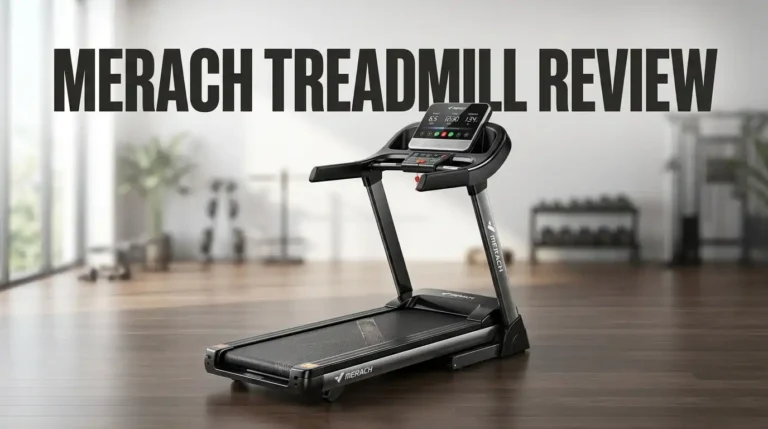

Echelon Stride Treadmill Review 2026: Worth Buying?
Home treadmills usually eat your floor space. The Echelon Stride tries to fix that problem with a folding design that drops almost flat on the ground. I spent weeks walking, jogging, and sprinting on this machine to find out if the space saving trick comes with real performance behind it.
This review covers the unboxing, the motor, the deck, the app, and the parts Echelon would rather you skip past.
You will get honest numbers, real complaints, and a clear answer about who should buy it. If you live in an apartment, a condo, or a small spare room, keep reading. The next few minutes could save you a thousand dollars.
In A Nutshell:
- The fold flat design is the headline feature. The console and handlebars drop down with hydraulic buttons, leaving a profile around 10.25 inches tall. You can slide it under a bed or stand it upright against a wall.
- The motor is modest. The original Stride runs a 1.75 CHP motor, while the newer Stride 6 steps up to a 2.5 CHP brushless motor. Neither one suits daily marathon training. Both handle walking and casual jogging well.
- Setup takes about 10 minutes. The treadmill ships fully assembled. You cut the box, unfold the arms, plug in the safety key, and start walking.
- There is no built in touchscreen on the base models. You supply your own phone or tablet. The Echelon Fit membership costs around $39.99 monthly or $399.99 yearly.
- The deck size varies by model. The original Stride uses a 55 inch belt. The Stride 6 widens things to 20.5 by 60 inches, which fits taller runners much better.
- Price sits near $1,000 for the original and $1,699 list for the Stride 6. Discounts show up often, so patience pays.
Echelon Stride Treadmill Overview


Last update on 2026-10-17 / Affiliate links / Images from Amazon Product Advertising API
The Echelon Stride launched in 2020 and still holds a spot on most compact treadmill lists. The machine weighs 156 pounds, which sounds heavy until you compare it to the 300 pound monsters from other brands. It supports users up to 300 pounds. Top speed hits 12 miles per hour. Incline climbs to 10 percent on the original model.
Echelon built this treadmill around one idea: storage. Most folding treadmills lift the deck upward into a vertical position. The Stride does the opposite. The uprights and console fold down toward the belt. The result looks like a thick walking pad lying on your floor.
The frame uses steel with plastic housing. It feels solid underfoot. It does not feel like a commercial gym machine, and the price reflects that honestly.
The Unboxing Experience
The box arrives large, flat, and heavy. Delivery drivers usually drop it at your door, so plan for a second pair of hands. I cut the tape along the seams and folded the cardboard walls outward instead of lifting the machine out. That trick saves your back.
Inside you find the treadmill already assembled, a power cord, a safety key, a chest heart rate strap, and a small manual. There are no tools, no bolts, and no confusing diagrams. Setup took me under 10 minutes from box cutter to first walk.
The only awkward moment comes when lifting the unit off the cardboard base. At 156 pounds, it is manageable for two people and risky for one. My advice: unbox it in the room where you plan to keep it. Dragging it through doorways afterward gets annoying fast.
Fold Flat Design And Storage
This is the reason most people buy the Stride. Press two buttons on the uprights and the handlebars lower on hydraulics. The motion feels controlled, not loose. The machine settles to roughly 10 inches tall.
From there you have options. A rear handle lets you tip the unit up and roll it on transport wheels. You can park it vertically in a closet corner or slide it horizontally under furniture. I stored mine upright behind a door for three weeks and forgot it existed.
Very few treadmills in this price range offer vertical storage. Most folding models still need a dedicated six foot footprint even when closed. The Stride does not. For apartment dwellers, that difference alone justifies the price gap over cheaper walking pads.
Running Deck And Cushioning
The original Stride uses a 20 by 55 inch belt. The newer Stride 6 upgrades that to 20.5 by 60 inches, which matches what most trainers recommend for running. If you stand close to six feet tall, the shorter 55 inch deck will feel cramped during faster intervals.
Cushioning sits in the middle of the pack. The deck absorbs more shock than pavement, and my knees noticed the difference after a 30 minute jog. It does not match the plush feel of higher end machines with multi zone suspension. Think supportive, not luxurious.
One design touch deserves praise. The front of the belt uses an open waterfall edge instead of a bulky motor hood. That open front removes the fear of clipping plastic with your toe when your stride drifts forward.
Top 3 Alternatives For Echelon Stride Treadmill

Last update on 2026-10-17 / Affiliate links / Images from Amazon Product Advertising API
Horizon Fitness T101 Folding Treadmill

Last update on 2026-10-19 / Affiliate links / Images from Amazon Product Advertising API
NordicTrack T Series 6.5S Treadmill

Last update on 2026-10-17 / Affiliate links / Images from Amazon Product Advertising API
XTERRA Fitness TR150 Folding Treadmill
Motor Power And Speed Performance
Here is where honesty matters. The original Stride carries a 1.75 continuous horsepower motor. Industry guidance suggests 2.5 CHP or higher for regular running. The Stride 6 meets that bar with a 2.5 CHP brushless motor.
At walking and jogging speeds, the smaller motor behaves fine. I pushed the belt to 12 miles per hour and the frame held steady without wobble. The motor did not stall or surge. But sustained high speed running week after week will shorten its life.
Think of it this way. A lighter motor working near its limit wears faster than a stronger motor coasting at half effort. If you run four or five times per week at pace, pick a machine with more power. If you walk, hike inclines, and jog twice a week, the Stride handles your routine without complaint.
Incline Range And Workout Variety
The original Stride climbs to 10 percent incline. The Stride 6 reaches 12 percent. Neither offers decline, which some competitors include.
Incline control sits on the handlebars rather than the console. On the Stride 6, Echelon uses quick adjust thumb wheels. You roll forward for faster, backward for slower. The idea works well for interval sessions because your hands never leave the bars.
There is a learning curve. The wheel sensitivity takes a few sessions to master, and I overshot my target speed more than once during the first week. Give yourself a practice run before attempting a serious interval workout.
Incline walking remains the smartest use of this machine. A 10 percent grade at 3.5 miles per hour burns serious calories while keeping stress off your joints and off the motor.
Console And Display Quality
The base Stride uses a simple LCD panel. It shows time, speed, distance, calories, and heart rate. There is no touchscreen. There is no map, no video, and no color.
Echelon represents incline with dots and speed with small lines. My honest reaction: it works, but it looks dated. Reading your exact incline level at a glance takes effort. A numeric readout would solve this in one firmware update.
The console includes a media shelf sized for a tablet, two water bottle holders, and a USB charging port. The shelf holds a large iPad securely, which matters because you must supply your own screen for classes.
If a built in display is important to you, Echelon sells the Stride 6S with a 10 inch HD touchscreen for roughly $300 more. That upgrade solves the complaint entirely.
Echelon Fit App And Membership Costs
The Echelon Fit app connects over Bluetooth. Membership runs $39.99 per month or $399.99 per year. You get thousands of live and on demand classes, bootcamps, yoga, strength sessions, and leaderboards.
The running classes feature a coach on a Stride calling out speed and incline targets. You adjust manually. The app does not auto control your treadmill, which puts it behind iFIT and Peloton in convenience.
Content quality is good. Instructors are energetic and the class library is deep. Scenic runs exist but feel thin compared to rivals filming in Iceland and Kenya.
Good news for budget shoppers: the Stride works without a subscription. Eight built in programs cover hills, intervals, and manual sessions. You lose the classes, not the treadmill.
Noise Levels During Use
The Stride runs quieter than I expected from a lightweight frame. At walking speed, I held a normal phone conversation without raising my voice. At jogging pace, the belt noise stays below the sound of my footfalls.
There is a known quirk worth flagging. Several testers, including me, noticed a squeak or squeal during the first minutes of a session. The sound fades once the deck warms up. Echelon support points to belt lubrication and front roller bearings as the usual causes.
Regular silicone lubrication under the belt solves most of it. If the squeal persists after lubrication, contact support while your warranty remains active. Downstairs neighbors will still hear impact vibration during running, so a thick treadmill mat remains a smart purchase.
What The Echelon Stride Does Not Do Well
Every review should name the flaws clearly. Here are mine.
The warranty is weak on the original model. One year of coverage sits well below industry standard. The Stride 6 improves this with 10 years on the frame and 5 years on the motor.
Data tracking locks you into Echelon. Bluetooth works only with the Echelon Fit app. You cannot push metrics directly into third party apps without that subscription layer.
The 55 inch deck limits tall runners. Anyone near or above six feet will feel boxed in during fast running.
The motor is undersized for serious mileage. Marathon trainees should look elsewhere.
None of these flaws make the Stride a bad treadmill. They make it a specific treadmill for a specific buyer.
Pros And Cons Of The Echelon Stride
Pros
- Folds almost completely flat to roughly 10 inches tall for easy storage
- Arrives fully assembled and takes about 10 minutes to set up
- Lightweight at 156 pounds with front transport wheels and a rear lift handle
- Stores vertically or horizontally, which is rare at this price
- Speed and incline controls sit directly on the handlebars
- Supports users up to 300 pounds
- Heart rate chest strap included in the box
- Works fine without a paid subscription thanks to eight built in programs
Cons
- The 1.75 CHP motor on the original model is underpowered for frequent running
- The 55 inch deck feels short for taller users
- One year warranty on the base model is below average
- Basic LCD console with no touchscreen or numeric incline display
- Bluetooth data syncs only with the Echelon Fit app
- Membership costs $39.99 monthly, which adds up quickly
- Occasional squeaking at startup until the belt warms
- Cushioning is adequate rather than plush
Who Should Buy The Echelon Stride
Buy this treadmill if you live in a small space and need the floor back after every workout. Apartment residents, condo owners, and anyone sharing a room with their gym equipment will appreciate the fold flat design every single day.
It suits walkers, incline hikers, and casual joggers best. If you log three or four moderate sessions per week, the motor will serve you for years.
Skip it if you are training for a marathon, if you weigh close to the 300 pound ceiling, or if you stand well over six feet tall. Skip it also if you want a big screen experience out of the box. The Stride 6S or a NordicTrack with iFIT will make you happier in those cases.
Price And Value In 2026
The original Echelon Stride sells around $1,000 on third party sites, down from its $1,500 launch price. The Stride 6 lists at $1,699.99 and discounts regularly. The Stride 6S with the 10 inch screen adds roughly $300.
Value depends on how much you weigh the storage feature. Compared to a Sole F63 or Horizon T101, you pay a premium for folding flat and arriving assembled. Compared to a NordicTrack Commercial 1750, you save over a thousand dollars and give up motor power plus screen size.
My take: the Stride 6 offers the better long term buy because of the stronger motor, the longer deck, and the far better warranty. The original Stride makes sense only at a deep discount.
Maintenance Tips For Longer Life
Treat the Stride well and it will last. Lubricate the deck with 100 percent silicone oil every three months or every 150 miles, whichever comes first. Echelon support recommends this specifically to stop the squeaking issue.
Check belt tension monthly. A belt that slips under your foot needs a quarter turn on each rear roller bolt. A belt that drifts sideways needs the same adjustment on one side only.
Wipe the deck and console after every session. Sweat corrodes electronics faster than mileage does.
Vacuum under the machine every few weeks. Dust buildup around the motor cover is the quiet killer of home treadmills.
Store it folded when not in use. Less exposure means less dust and fewer accidental bumps.
Final Verdict
The Echelon Stride solves a real problem with genuine cleverness. It folds flatter than almost anything else in its class, it arrives ready to use, and it moves around your home without a struggle.
It is not a performance treadmill. The motor, the deck length, and the basic console all remind you of the price point. Echelon made clear trade offs to deliver the folding design, and those trade offs show up during hard running.
For walkers and recreational joggers in small spaces, this is an easy recommendation. For serious runners, it is the wrong tool. Know which group you belong to and the decision answers itself.
Frequently Asked Questions
Is the Echelon Stride good for running?
It handles running, but it suits jogging better. The 55 inch deck on the original model feels short for tall runners, and the 1.75 CHP motor was not built for daily high mileage. The Stride 6 with its 60 inch deck and 2.5 CHP motor performs noticeably better for runners.
Can I use the Echelon Stride without a subscription?
Yes. The treadmill includes eight built in workout programs covering hills, intervals, and manual mode. The LCD console displays all your core metrics without any app connection. You lose the live classes and leaderboards, nothing else.
How much does the Echelon Fit membership cost?
The Premier membership runs $39.99 per month or $399.99 per year. Annual billing saves roughly 17 percent. New treadmill purchases typically include a 30 day free trial.
How flat does the Echelon Stride fold?
The console and handlebars fold down to leave the machine about 10.25 inches tall. That height lets it slide under most beds or stand upright in a closet.
Does the Echelon Stride need assembly?
No. It ships fully assembled. You unfold the handlebars, insert the safety key, and plug it in. Most people finish in under 10 minutes.
What is the weight limit on the Echelon Stride?
The maximum user weight is 300 pounds. Users closer to that limit should consider the Stride 6 or a model with a stronger motor for better longevity.
Why does my Echelon Stride squeak?
Startup squeaking usually comes from a dry deck or a front roller bearing. Apply 100 percent silicone lubricant under the belt first. If the noise continues, contact Echelon support at 1 833 937 2453.
Is the Echelon Stride better than the Horizon T101?
The Stride wins on storage and arrives assembled. The Horizon T101 costs less and offers a lifetime frame warranty. Choose the Stride if space matters most, and the T101 if budget matters most.

Hi, I’m Sarah Hill — the founder and voice behind Heavy Lift Vault. I’m passionate about fitness, strength training, and health technology. I spend my time researching, testing, and reviewing workout equipment and health devices so you don’t have to guess. My goal is to deliver honest, detailed, and trustworthy reviews that help you invest wisely in your fitness journey.