DeerRun Walking Pad Review 2026: Worth It?
Walking while you work sounds like a gimmick until you try it. Then your step count jumps from 2,000 to 9,000 without a single trip to the gym.
The DeerRun walking pad is one of the cheapest ways to make that happen, and it keeps showing up in budget treadmill lists for good reason. But cheap can mean cheerful or cheap can mean regret.
This review covers what DeerRun gets right, what it quietly gets wrong, and whether it deserves a spot in your home office this year.
Key Takeaways
- The DeerRun walking pad costs under $300, and it often drops closer to $200 during sales. That price buys you a quiet brushless motor, a remote, and a digital display. It is one of the best value picks in the category.
- Noise levels sit around 55 dB at top speed. That is quiet enough for video calls if your mic is decent. DeerRun advertises 45 dB, which is optimistic.
- The belt measures roughly 15.4 by 39.4 inches. That is narrow and short. Tall walkers with long strides will feel boxed in, especially above 3 MPH.
- Newer models add incline. The Q2 Urban offers 7% manual incline and the Z10 offers 12 levels of automatic incline up to 9%. Incline changes everything about calorie burn.
- It is built for 30 minutes to 2 hours of daily walking, not for all day marathon sessions. Push it harder and the motor gets louder over time.
- No handrails on most models. You need a standing desk or a wall nearby for balance and confidence.
What Is The DeerRun Walking Pad?

Last update on 2026-10-17 / Affiliate links / Images from Amazon Product Advertising API
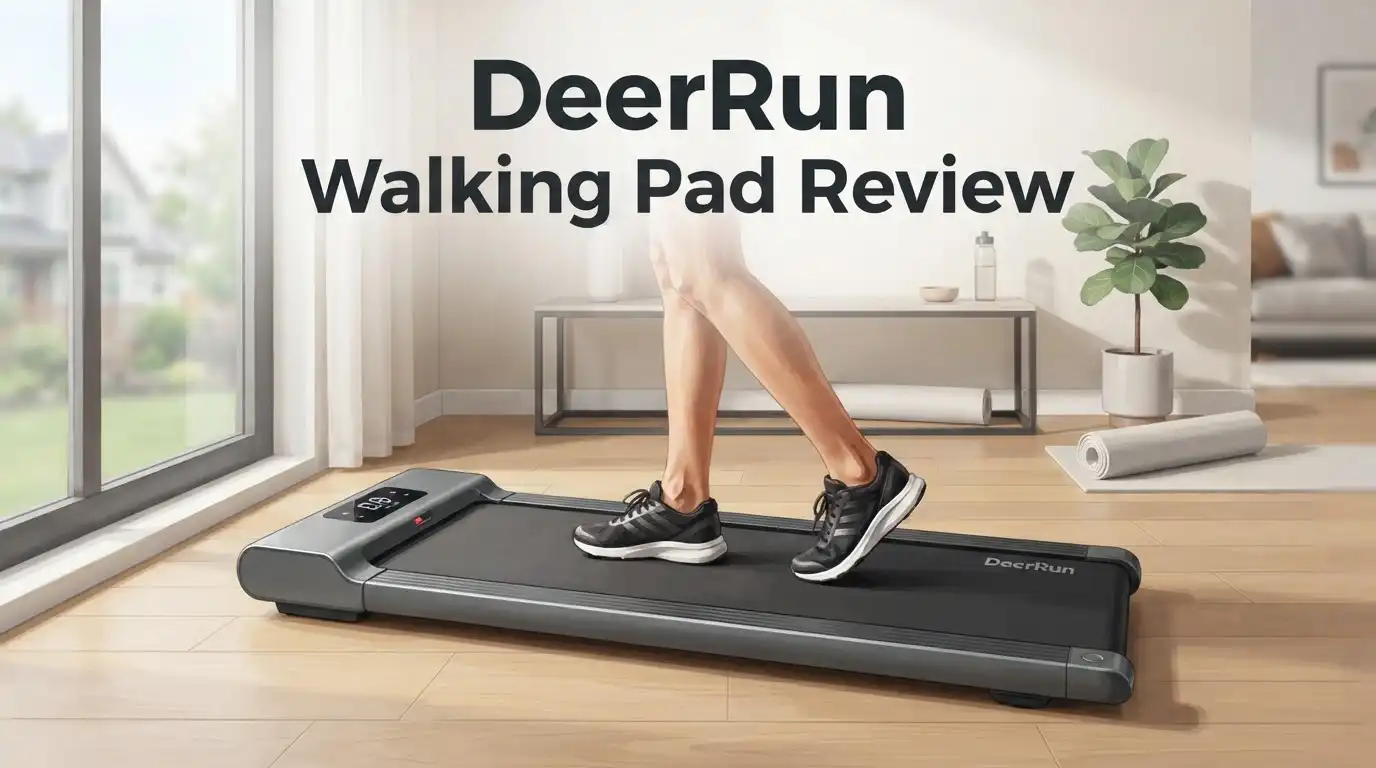
The DeerRun walking pad is a flat treadmill built to slide under a desk or a bed. It has no tall console, no handrails on the base models, and no complicated assembly. You unfold nothing. You plug it in, press start on the remote, and walk.
Speed runs from 0.6 to 3.8 MPH, which covers slow strolling to a brisk walk. The deck sits about 4.5 inches off the floor, so stepping on feels natural rather than like climbing onto a platform. Weight capacity is 300 lb on most models, which is generous for something this small.
DeerRun sells several versions. The Q1 Classic Pro and Q1 Urban Plus are the simple ones. The Q2 Urban adds manual incline. The Z10 adds automatic incline. All of them share the same core idea: move more while you do something else.
Unboxing The DeerRun Walking Pad
The box arrives heavier than you expect. The pad weighs around 43 lb, and the packaging adds a few more pounds. I dragged mine into the office rather than carrying it, which felt like the smarter choice.
Inside, the foam protection is thick and sensible. You get the walking pad, a remote control with a wrist strap, a power cord, a small silicone oil bottle, and a thin manual. That is the entire kit. No tools, no bolts, no missing hardware drama.
Setup took me under four minutes. I peeled off the protective film, placed the pad on the floor, plugged it in, and the display lit up instantly. The first beep is loud. Every speed change beeps too, which I found charming for one day and mildly annoying by day three.
Design And Build Quality
The DeerRun looks plain, and I mean that as a compliment. A matte shell, a slim motor hood at the front, and a dark belt. It blends into a room instead of shouting about fitness.
The frame mixes steel and plastic. The steel carries the load and the plastic keeps the weight down. The plastic side rails flex slightly if you stand on the very edge, so place your feet properly and you will be fine.
Fit and finish is better than the price suggests. Panel gaps are even and nothing rattled out of the box. Some long term owners on forums report a rattle developing after several months of heavy use, usually from loose side panels. Tightening the visible screws every few weeks prevents most of that. The belt itself feels dense and grippy underfoot.
Top 3 Alternative for DeerRun Walking Pad

Last update on 2026-10-17 / Affiliate links / Images from Amazon Product Advertising API
UREVO Walking Pad with Manual Incline

Last update on 2026-10-17 / Affiliate links / Images from Amazon Product Advertising API
Sperax Walking Vibration Pad
No products found.
FLEXISPOT Foldable Walking Pad Treadmill
DeerRun Z10 Walking Pad With 12% Auto Incline

Last update on 2026-10-17 / Affiliate links / Images from Amazon Product Advertising API
The Z10 is the model I recommend to anyone who wants more than flat walking. It offers 12 automatic incline levels reaching about 9%, controlled from the remote or the app. You almost never see motorised incline at this price.
Why does incline matter? Walking at 2.5 MPH on a 6% grade burns roughly as many calories as jogging on flat ground, and it does so without pounding your knees. Your calves and glutes actually work.
The trade off is noise and heat. The incline motor adds a soft whir, and the unit runs warmer during long sessions. The Z10 is also slightly heavier and taller than the flat models, so it will not slide under every low sofa. If you want one walking pad to cover both desk work and real exercise, the Z10 is the smarter buy.
Motor Power And Noise Levels
DeerRun uses a brushless motor rated between 2.5 HP and 3.0 HP depending on the model. Brushless motors run cooler, last longer, and stay quieter than brushed motors. That is a genuine win at this price.
I measured 55 dB at top speed with a phone app. DeerRun claims 45 dB. Reality sits in between depending on your flooring. On carpet it is noticeably softer. On hardwood it buzzes more, so buy a mat.
The sound itself matters as much as the volume. The DeerRun produces a low hum rather than a high whine, and my coworkers rated it the least irritating pad I have tested. Colleagues on video calls never once asked what the noise was.
One honest note: after six months of near daily use, the motor got slightly louder. Not broken, just older sounding.
Belt Size And Walking Comfort
This is the section that decides the purchase for many people. The walking surface measures about 15.4 inches wide and 39.4 inches long. A standard gym treadmill gives you 20 by 60 inches.
At 1.5 to 2.5 MPH, the size feels fine. Your stride stays short and centred. Above 3 MPH, the deck starts feeling small, and taller walkers will drift toward the front roller without realising it.
Cushioning is moderate. The deck absorbs enough impact for walking but offers nothing for jogging. Your knees will notice after 90 minutes.
The footrails deserve praise. They are wider than most rivals, so you can step off to the sides for a quick break without stopping the belt. That small detail makes daily use far less frustrating than it sounds.
Remote Control, Display And The PitPat App
The remote is pocket sized with a wrist strap. It starts, stops, and adjusts speed, and the range is solid across a normal room. Losing it is the main risk, since there are no buttons on the pad itself on some models.
The display sits on the motor hood and shows time, speed, calories, and distance. It is bright and readable from standing height. A step counter is missing, which feels like an odd omission. I use my watch instead.
Bluetooth connects the pad to the PitPat app. PitPat works as a backup remote, tracks sessions, and adds gamified races, classes, and an AI coach. Some content is free and some sits behind a subscription.
My gripe: PitPat asks for a lot of phone permissions. You can skip the app entirely and lose nothing essential.
Storage And Portability
The DeerRun stands under 5 inches tall. It slides under a bed, a sofa, or a low console table with room to spare. You can also stand it upright against a wall, which is how I store mine.
At 43 lb, it is liftable but not light. Shorter users will find the length awkward more than the weight. Two small transport wheels at the front help you tilt and roll it across a room.
There are no folding hinges on the flat models, so what you see is the storage size. That simplicity is actually a durability advantage, because folding hinges are the first part to fail on cheaper treadmills.
If you need to move it between floors regularly, grab a helper. Carrying it up a staircase alone is possible but not enjoyable.
What The DeerRun Walking Pad Does Not Do Well
Honest reviews list the flaws, so here they are without sugar coating.
It cannot run. The 3.8 MPH ceiling and the short deck make jogging unsafe. Treat this as a walking tool only.
It beeps constantly. Every speed change triggers a beep, and you cannot disable it. In a shared office this becomes a personality trait.
It is not an all day machine. DeerRun positions it for casual use, and the motor agrees. Running it eight hours daily will shorten its life considerably.
Build longevity is average. Some owners report rattles and loose side rails after a few months. The one year warranty is short compared to premium brands.
No handrails on base models. Balance is on you. Anyone unsteady on their feet should choose the handrail version or a different machine entirely.
Pros And Cons Of The DeerRun Walking Pad
Pros
- Excellent price for a brushless motor and a 300 lb capacity
- Quiet low frequency hum that suits home offices and video calls
- Genuinely slim profile that stores under beds and sofas
- Wider than average footrails make stepping on and off easy
- Remote control plus optional app control through PitPat
- Newer Q2 and Z10 models add real incline for harder workouts
- Zero assembly required out of the box
Cons
- Narrow and short belt that limits longer strides
- Beeps on every single speed change with no mute option
- No step counter on the display
- Top speed of 3.8 MPH rules out jogging
- Only a one year warranty
- Motor noise increases gradually over months of use
- No handrails on most versions, so balance support is missing
How It Compares To Other Walking Pads
Against the WalkingPad C2, the DeerRun wins on price and loses on brand polish. The C2 folds in half for tighter storage but costs noticeably more for similar performance.
Against UREVO models, the race is close. UREVO offers stronger cushioning systems and often a higher incline range, while DeerRun usually undercuts on price. If cushioning matters to your knees, UREVO edges ahead.
Against Sperax, DeerRun feels more refined. Sperax owners frequently mention belt drift, which requires manual tensioning. I never had that issue with the DeerRun.
The summary is simple. DeerRun is the value pick. It is not the quietest, the widest, or the best built pad available. It is the one that delivers the most usable walking per dollar spent.
Who Should Buy The DeerRun Walking Pad In 2026?
Buy it if you work from home and sit too much. Buy it if you want to hit 10,000 steps while answering emails. Buy it if your budget sits firmly under $300.
It suits shorter and average height users best. Anyone over six feet with a long stride should measure carefully or choose a wider deck.
Buy it if you have limited space. The under bed storage is a real selling point in apartments.
Skip it if you want to run, if you need all day durability, or if you are shopping for someone with balance concerns. Skip it also if silence is non negotiable in your workspace, because it is quiet but not silent.
Price And Value In 2026
The DeerRun walking pad typically lists between $200 and $300 depending on the model and the incline features. Sales push the flat models closer to $150, which is remarkable for a brushless motor machine.
Compare that to premium walking pads at $500 to $900. You lose deck width, warranty length, and a little refinement. You keep the core function entirely.
Value depends on honesty about your habits. If the pad sits unused in a closet, any price is wasted. If it adds 6,000 steps to your day, it pays for itself in a month of better energy and fewer stiff afternoons.
My verdict on value: strong. This is the machine that proves whether you will actually use a walking pad before you spend serious money on one.
Final Verdict
The DeerRun walking pad earns a recommendation with clear limits. It is quiet, slim, affordable, and ready to use in minutes. The remote works well, the footrails are thoughtfully wide, and the incline models add genuine training value.
It is also narrow, beepy, lightly warrantied, and built for moderate use rather than constant use. Nothing about it feels premium, and nothing about it needs to.
If you want one sentence: the DeerRun is the best walking pad for people who want to test the habit without draining their wallet. Pick the Z10 if you want incline, the Q2 Urban if you want incline on a budget, and the Q1 if you simply want to walk while you work.
Frequently Asked Questions
Is the DeerRun walking pad quiet enough for video calls?
Yes, in most cases. It produces around 55 dB at top speed, which is a low hum rather than a sharp whine. At typical desk walking speeds of 2 MPH, it is noticeably quieter. A rubber mat under the unit cuts floor vibration further. Colleagues rarely notice it on calls.
Can you run on a DeerRun walking pad?
No. The top speed is 3.8 MPH and the deck is under 40 inches long. That combination makes running unsafe. Treat the DeerRun strictly as a walking machine. If you want to run, look at the DeerRun A1 Pro foldable treadmill instead, which reaches higher speeds and includes a handlebar.
How long does the DeerRun walking pad last?
With moderate use of 30 minutes to 2 hours daily, owners commonly report two to three years of reliable service. Heavy all day use shortens that considerably. Lubricating the belt every three months and tightening visible screws extends life meaningfully. The warranty covers one year.
Do you need the PitPat app to use it?
No. The pad works fully with the included remote and the built in display. PitPat adds tracking, classes, races, and an AI coach, plus a backup remote function on your phone. Some features require a subscription. The app also requests broad phone permissions, which some users prefer to avoid.
Which DeerRun model should I choose?
Choose the Q1 for the lowest price and simplest flat walking. Choose the Q2 Urban if you want 7% manual incline without spending much more. Choose the Z10 if you want 12 levels of automatic incline and plan to use the pad as real exercise equipment. Incline models deliver far better calorie burn.

Hi, I’m Sarah Hill — the founder and voice behind Heavy Lift Vault. I’m passionate about fitness, strength training, and health technology. I spend my time researching, testing, and reviewing workout equipment and health devices so you don’t have to guess. My goal is to deliver honest, detailed, and trustworthy reviews that help you invest wisely in your fitness journey.