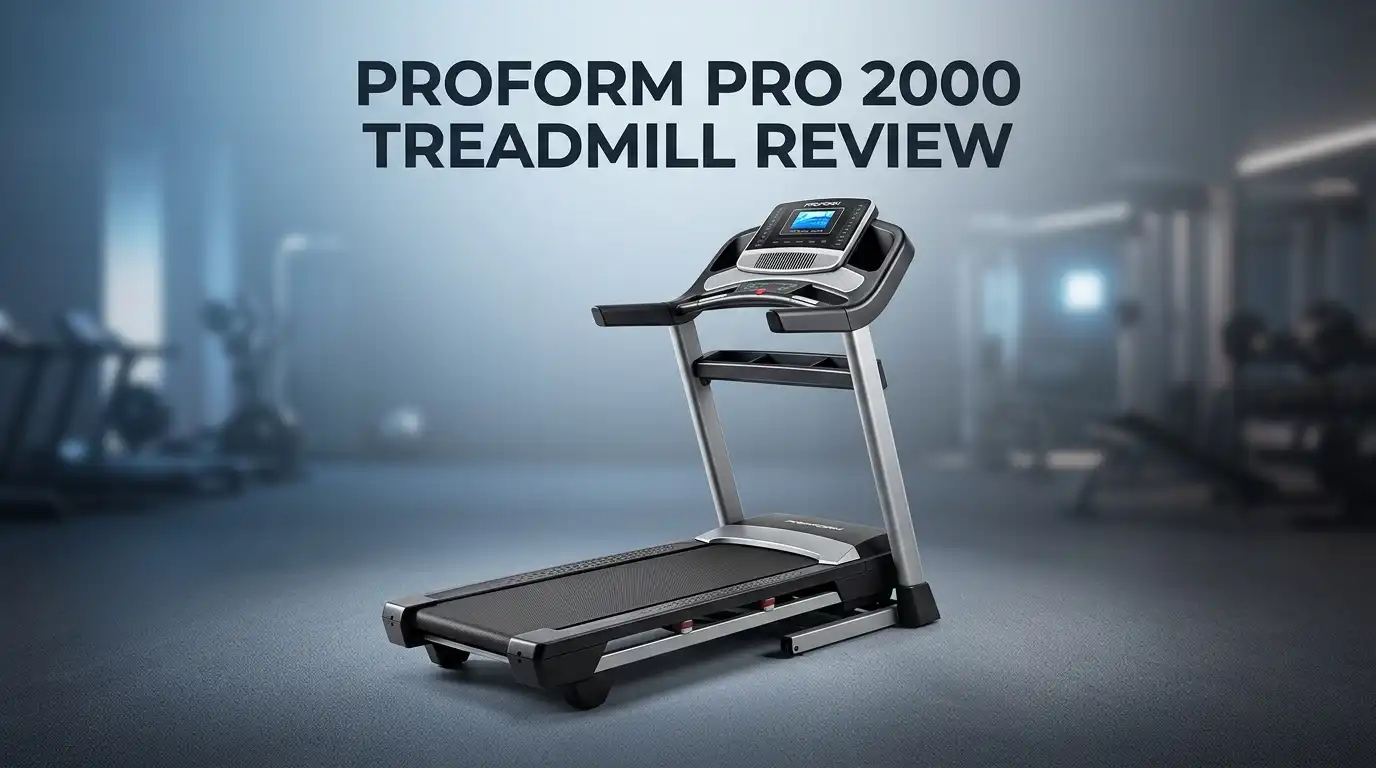
ProForm Pro 2000 Treadmill Review 2026: Worth Buying?
The ProForm Pro 2000 keeps showing up on shortlists, and for good reason. It sits in the mid price bracket, carries a 10 inch touchscreen, and offers both incline and decline.
That combination usually costs a lot more. But a spec sheet never tells you how a treadmill feels at 6 a.m. in a cold basement. It never tells you whether the belt drifts after four months or whether the screen freezes mid interval.
This review looks at the parts that matter. You get the unboxing story, the assembly headaches, the honest weak points, and a clear answer on who should skip it.
In a Nutshell:
- The Pro 2000 is a walking and jogging machine first. It handles 3 to 6 mph beautifully. Push past 7 mph regularly and you start feeling the limits of the belt length and motor rating.
- Incline and decline are the standout features. You get a range that runs from a 3 percent decline up to a 15 percent incline on most listings. Very few treadmills near this price offer decline at all, and it changes how your calves and shins feel after a hill session.
- The touchscreen is the best feature and the biggest complaint. iFIT streaming works well when it works. Owners report occasional freezing, and a soft reset fixes it. Without an active subscription, you drop back to plain manual controls.
- Assembly quality is inconsistent. Some buyers finish in under two hours. Others hit misaligned bolt holes or missing hardware and wait on customer service.
- Weight capacity sits around 300 to 325 pounds depending on the model year. That covers most users, but heavier runners should aim for more headroom.
- Value depends entirely on sale timing. Full price feels steep. Holiday pricing turns it into a genuinely smart buy.
ProForm Pro 2000 Treadmill: The Quick Verdict


Last update on 2026-10-17 / Affiliate links / Images from Amazon Product Advertising API
The ProForm Pro 2000 is a capable mid tier home treadmill that trades raw mechanical muscle for screen technology. You get a 10 inch HD touchscreen, iFIT compatibility, a 20 by 60 inch tread belt, a 3.25 CHP motor on current listings, and powered incline plus decline. The frame stays rigid during walking and steady jogging. The belt tracks straight out of the box.
It earns its price when you actually use the guided workouts. The trainer led sessions adjust speed and grade automatically, which turns a boring 30 minutes into something you finish without checking the clock. That feature alone separates it from cheaper flat deck machines.
Where it stumbles is heavy daily running. The motor works harder at sustained speeds above 7 mph, and taller runners with long strides feel boxed in near the front roller. Treat it as a strong walking, hiking, and jogging tool and you will be happy. Treat it as a marathon training rig and you will be frustrated.
Key Specs at a Glance
Here is the short version of what ProForm puts on the box, reworded into plain language. The motor is rated at 3.25 continuous horsepower on the current Pro 2000 listing, though some model years show 3.0 CHP. Continuous horsepower matters more than peak numbers because it reflects what the motor sustains hour after hour.
Speed tops out at 12 mph. The belt measures 20 inches wide by 60 inches long, with cushioning under the deck to soften heel strike. Incline runs up to 15 percent, and decline drops to 3 percent below flat. Weight capacity lands at 300 pounds on most listings, with some sources quoting 325 pounds.
The console holds a 10 inch HD touchscreen, Bluetooth heart rate connectivity, built in speakers, a cooling fan, a tablet ledge, and a water bottle tray. Folded footprint is manageable thanks to a hydraulic assist lift. Assembled weight sits near 260 pounds, so plan your placement before you build it.
Unboxing and Assembly Experience
The box arrives heavy and awkward. Mine showed up on a pallet, and two people moved it into the garage without drama. Inside, the frame sits under thick foam blocks, the uprights are wrapped separately, and the console comes in its own padded sleeve. Hardware arrives sorted into labeled bags, which helps more than you expect.
The instruction booklet uses clear diagrams rather than dense text. Realistic build time is 90 minutes to two hours with a helper. Solo assembly is possible but wrestling the uprights into place alone is genuinely rough.
Here is the honest part. Bolt hole alignment is the common friction point. Two of my upright bolts needed firm pressure and a slight frame nudge before they threaded cleanly. Owner reports back this up, and a handful describe missing screws entirely. Keep a rubber mallet and a socket wrench nearby instead of relying only on the included Allen key. Once assembled, the machine feels far more solid than the build process suggests.
Top 3 Alternative for ProForm Pro 2000 Treadmill

Last update on 2026-10-17 / Affiliate links / Images from Amazon Product Advertising API
NordicTrack Commercial Series Treadmill

Last update on 2026-10-17 / Affiliate links / Images from Amazon Product Advertising API
Sole Fitness F63 Folding Treadmill

Last update on 2026-10-17 / Affiliate links / Images from Amazon Product Advertising API
Horizon Fitness 7.0 AT Smart Treadmill
Deck Size, Belt, and Cushioning
The 20 by 60 inch belt is the spec that decides your daily comfort. For walking, it feels generous. For jogging at 5 to 6 mph, it stays comfortable for most users. Runners over six feet tall with a long stride will notice the edges. Testers in that height range report feeling slightly cramped near the front and rear of the deck during faster intervals.
Cushioning is tuned for a broad range of body types rather than one specific build. It softens heel impact noticeably compared to running on pavement, and knees appreciate that after a few weeks. It does not match the plush feel of premium decks that cost twice as much.
Belt tracking is another point worth flagging. Several owners find the belt drifts off center after a few months of steady use, especially heavier runners applying more lateral force. The fix is a simple tension and alignment adjustment using the rear roller bolts. It takes ten minutes, but it becomes a recurring chore rather than a one time fix.
Motor Power and Speed Performance
The 3.25 CHP motor is respectable for this price tier. During walking sessions at 3 to 4 mph, it runs quietly and holds pace with zero hesitation. Incline changes engage smoothly without grinding or lag. Nothing about the daily walking experience feels underpowered.
Speed response is decent rather than instant. Moving from 1 mph to 12 mph takes roughly 20 to 25 seconds, which is normal for this class but slow if you want sharp sprint intervals. Third party testing also found the belt loses a small amount of speed under a heavier user, which suggests the motor controller prioritizes smoothness over strict accuracy.
Sustained running is the honest weak point. A heavier user holding 7 or 8 mph for 30 minutes puts real strain on a motor in this range, and that shortens lifespan over years of use. Compare that with 3.5 to 4.0 CHP machines built for higher mileage. For walkers, joggers, and interval users, the motor is plenty.
Incline and Decline: The Real Highlight
This is where the Pro 2000 genuinely outperforms its price. A 3 percent decline paired with a 15 percent incline gives you a training range most machines under this bracket simply skip. Decline is rare at any price below premium, and it matters more than the marketing suggests.
Walking at a steep incline burns serious calories without asking your joints to absorb running impact. That single feature makes the Pro 2000 useful for people who cannot run or choose not to. Hikers training for real elevation get even more from it.
The decline setting works your calves, shins, and stabilizer muscles in a way flat walking never does. If you are prepping for a downhill trail race, this is worth the whole purchase. Grade changes happen smoothly during iFIT guided sessions, shifting automatically as the on screen terrain rises and falls. No jerking, no delay. The incline motor is one of the quieter and better executed parts of this machine.
Touchscreen and iFIT Experience
The 10 inch HD touchscreen is responsive enough that you are not stabbing at it mid workout. Colors look sharp, viewing angles are fine, and the speakers push enough volume for instructor coaching. Bluetooth headphones still sound better for music.
iFIT is the reason this screen exists. The library includes trainer led runs, walking tours through real locations, hill sessions, and strength classes you can follow off the treadmill. The automatic incline and speed adjustment during those workouts is the feature people keep paying for.
Now the trade off. The screen depends on a subscription. Without an active iFIT plan, you fall back to basic manual mode and a small set of preloaded programs. Manual mode also feels clumsy, since the interface pushes you toward subscription content and you tap through several screens to simply start walking. Occasional freezing during streamed workouts is a common complaint. Firmware updates improved it, but a console restart every few weeks is still realistic.
Noise Levels and Folding Storage
Noise stays low enough for early morning use in a shared house. During walking and moderate jogging, the Pro 2000 produces a steady hum rather than a rattle. You can hold a conversation or watch television at normal volume. Push to higher speeds and steeper grades and vibration climbs noticeably, particularly for heavier users, though it never feels unsafe.
The folding design uses a hydraulic assist that lifts the deck with light pressure and lowers it slowly instead of slamming. That system works well and reduces the risk of a pinched finger.
Do not mistake folding for portable. The assembled machine weighs close to 260 pounds. Front transport wheels help you slide it across hard flooring, but moving it over carpet or through a doorway needs two people. Measure your ceiling height too, since the raised deck adds real vertical space. A rubber mat underneath cuts vibration transfer through the floor and protects your surface.
What the ProForm Pro 2000 Does Not Do Well
Every honest review needs this section, so here it is plainly. The Pro 2000 is not a serious running machine. The belt length limits long strides, and the motor rating is not built for daily high mileage. Runners logging 30 plus miles a week should look elsewhere.
The console software frustrates people who want simple operation. If you only want to press start and walk, you will resent the subscription prompts and the extra taps.
Quality control is uneven. Misaligned holes, missing hardware, and early belt drift show up across owner reports often enough to expect them. Customer support experiences swing widely, with some buyers resolved in days and others waiting weeks on a replacement part.
Weight capacity is middling. Anyone within 30 pounds of the limit should consider a sturdier frame. Finally, the warranty favors the frame over the parts you actually wear out, and the touchscreen carries the shortest coverage of all.
Pros and Cons
Pros
- Incline and decline range from 3 percent below flat up to 15 percent, which is rare at this price.
- Sharp 10 inch HD touchscreen with responsive taps and good viewing angles.
- iFIT guided workouts adjust speed and grade automatically, which keeps sessions interesting.
- Stable frame with minimal side to side flex during walking and steady jogging.
- Quiet operation at walking and jogging speeds, suitable for shared living spaces.
- Hydraulic assist folding that lifts easily and lowers safely.
- Bluetooth heart rate support, cooling fan, tablet ledge, and water bottle tray included.
- Frequent holiday discounts bring the price down significantly.
Cons
- Belt length feels short for taller runners with long strides.
- Motor works hard during sustained running above 7 mph.
- Touchscreen freezing during streamed workouts is a recurring owner complaint.
- Manual mode is clumsy and the console pushes subscription content.
- Full value requires an ongoing iFIT membership.
- Assembly quality varies, with reports of missing or misaligned hardware.
- Belt drifts off center after months of heavy use.
- Weight capacity of roughly 300 pounds limits heavier users.
- Support response times are inconsistent.
Who Should Buy the ProForm Pro 2000?
Last update on 2026-10-17 / Affiliate links / Images from Amazon Product Advertising API
Buy this treadmill if you are a walker, power walker, or moderate jogger who wants variety without joining a gym. The incline and decline range gives you months of different workouts, and the guided sessions solve the motivation problem that kills most home cardio habits. Hikers training for elevation get particularly strong value.
It also suits households where two or three people share one machine at different fitness levels. The automatic adjustments handle that well.
Skip it if you are a dedicated runner. Anyone training for a half marathon or faster needs a longer belt and a stronger motor. Skip it if you weigh close to the capacity limit, since you want margin rather than a ceiling. Skip it if you hate subscriptions, because the console loses most of its appeal in manual mode.
Buyers in small apartments should measure twice. The folded machine still occupies real space, and 260 pounds does not move easily between rooms.
Price, Warranty, and Value in 2026
The Pro 2000 usually lists in the upper mid range for home treadmills, and street pricing has landed anywhere from roughly 1,000 to 1,500 dollars depending on the retailer and the season. Sale timing changes the entire value story. Holiday events around Memorial Day, Labor Day, and Black Friday routinely knock several hundred dollars off, and the hardware is identical either way.
Warranty coverage typically runs 10 years on the frame, two years on parts, and one year on labor, with the tablet carrying the shortest term. Read the current terms before buying, since coverage has varied across model years.
Factor the iFIT subscription into your real cost. An annual family plan adds a meaningful amount, so decide whether you will actually use it. If you plan to run in manual mode, a cheaper treadmill with a larger deck makes more financial sense. Paid at full price with no subscription, the Pro 2000 feels overpriced. Bought on sale by someone who streams workouts, it feels like a bargain.
Final Verdict
The ProForm Pro 2000 is a good treadmill with a clear personality. It rewards walkers, incline lovers, and anyone who needs a screen and a trainer to stay consistent. The decline feature, the smooth grade changes, and the stable frame are genuine strengths that punch above the price.
It also has real flaws worth respecting. The belt is short for tall runners. The motor is not built for heavy mileage. The console freezes sometimes, assembly can test your patience, and the best features hide behind a subscription.
My recommendation is simple. Match the machine to your actual training. If your weekly plan involves brisk walking, hill sessions, and occasional jogging, buy it during a sale and enjoy it for years with basic belt maintenance. If your plan involves fast running four days a week, spend the extra money on a longer deck and a stronger motor. Honest fit beats a good deal every time.
FAQs
Is the ProForm Pro 2000 good for running?
It handles moderate running fine. The 60 inch belt and the motor rating suit jogging and interval work at 5 to 7 mph. Serious runners with long strides or high weekly mileage will outgrow it and should choose a machine with a longer deck and a 3.5 CHP or higher motor.
Do you need an iFIT subscription to use it?
No, the treadmill runs without one. You get manual control of speed and incline plus a small set of preloaded programs. That said, the touchscreen and the automatic workout adjustments are the main reasons to buy this model, so skipping the subscription wastes most of what you paid for.
What is the weight capacity of the ProForm Pro 2000?
Most listings state 300 pounds, while some sources quote 325 pounds depending on the model year. Check the specific listing before ordering. If your weight sits within 30 pounds of that number, choose a frame with a higher rating for better long term durability.
How long does assembly take?
Plan on 90 minutes to two hours with two people. Hardware arrives labeled and the diagrams are clear, but bolt alignment can fight you. Keep a socket wrench and a rubber mallet handy, and check the parts count against the manual before you start.
Does the ProForm Pro 2000 fold up?
Yes. The deck lifts with hydraulic assist and lowers slowly rather than dropping. Folding reduces the footprint meaningfully, though the machine still weighs close to 260 pounds and needs two people to relocate across carpet or through doorways.
Why does my belt drift to one side?
Uneven belt tension is the usual cause, and it becomes more common after months of use. Adjust the rear roller bolts a quarter turn at a time on the side the belt drifts away from, then run the belt at low speed to check alignment. Repeat until it tracks centered.
Is the Pro 2000 the same as the Carbon Pro 2000?
They are close relatives, not twins. The Carbon Pro 2000 replaced the older Pro 2000 with revised styling and slightly different specs, including a higher stated weight capacity on some listings. Compare motor rating, incline range, and warranty on the exact model you are viewing.

Hi, I’m Sarah Hill — the founder and voice behind Heavy Lift Vault. I’m passionate about fitness, strength training, and health technology. I spend my time researching, testing, and reviewing workout equipment and health devices so you don’t have to guess. My goal is to deliver honest, detailed, and trustworthy reviews that help you invest wisely in your fitness journey.