JEEKEE 8 in 1 Home Gym with Leg Press Review 2026: Worth Buying?
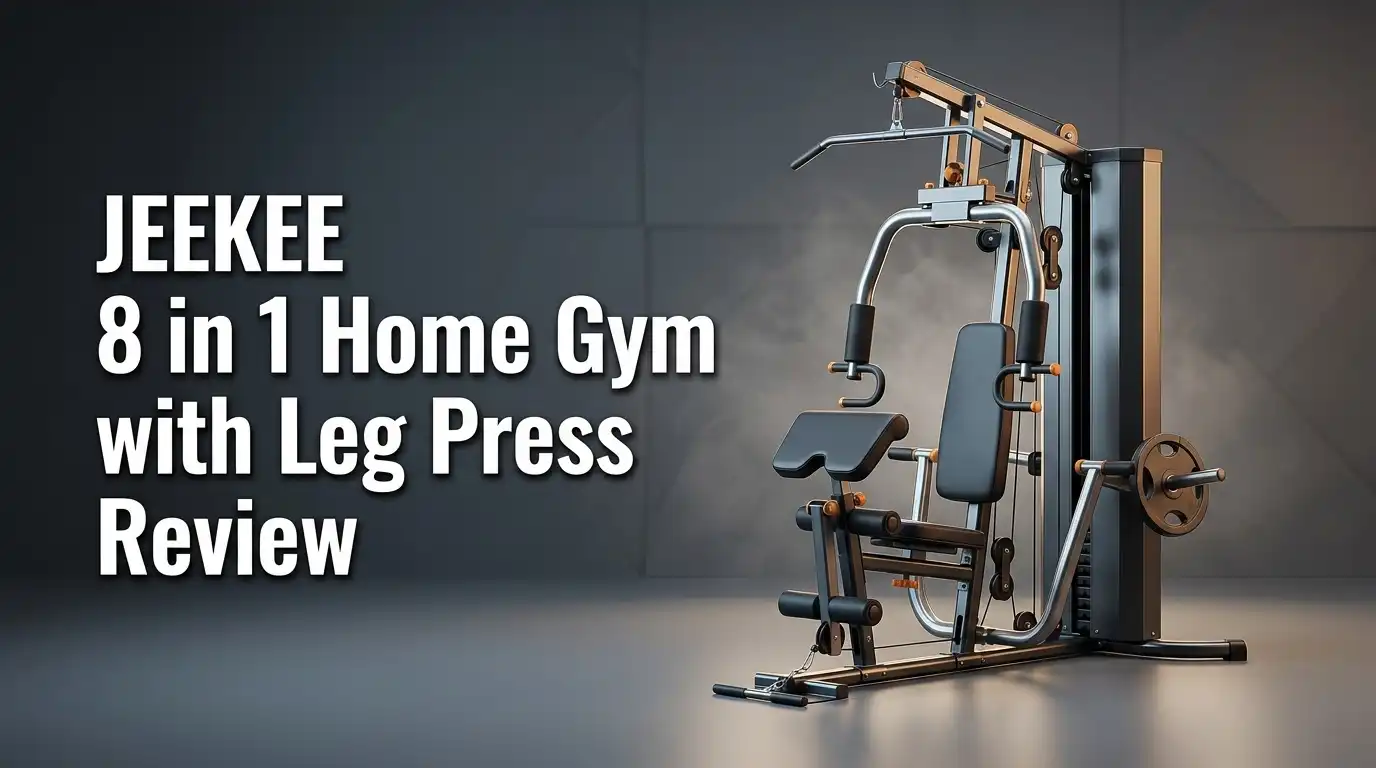
Home gym shopping gets confusing fast. You want strength training at home, but you do not want five separate machines crowding your garage. The JEEKEE 8 in 1 Home Gym with Leg Press promises one steel tower that handles your whole body.
It carries a 150 LB selectorized weight stack, a press arm, a lat tower, and a leg station in a footprint smaller than a loveseat.
I spent weeks with this machine, from the cardboard pile on the driveway to the fiftieth workout. This review covers the good parts, the annoying parts, and the things JEEKEE quietly leaves out of the listing.
In a Nutshell:
- The price is the headline. The JEEKEE usually lands near $400 to $570, which undercuts most selectorized single stack machines by hundreds of dollars. Comparable branded gyms start closer to $800.
- You get a real weight stack, not resistance rods or bands. The 150 LB pin loaded stack moves on guide rods and feels like a commercial gym machine at light to moderate loads.
- Assembly takes time. Plan for three to five hours with a helper. The instructions use pictures, the hardware bags are labeled, and patience matters more than skill.
- It covers 35 plus exercises. Lat pulldown, chest press, chest fly, low row, leg extension, leg curl, preacher curl, and ab crunch all live on one frame.
- It is built for beginners and intermediates. Strong lifters will outgrow the 150 LB stack on legs and rows within a year. There is no stack upgrade kit sold by JEEKEE.
- Footprint is roughly 79 inches tall by 39 inches wide by 67 inches deep. Low basements with 7 foot ceilings will struggle.
What Is the JEEKEE 8 in 1 Home Gym with Leg Press?

Last update on 2026-10-31 / Affiliate links / Images from Amazon Product Advertising API
The JEEKEE is a single stack multi station gym. One steel tower holds a 150 LB selectorized weight stack. Cables run from that stack through pulleys to four separate training stations. You change exercises by moving a pin, swapping an attachment, or simply turning around on the seat.
The eight listed functions are lat pulldown, chest press, chest fly or butterfly, low row, leg press or leg extension, leg curl, preacher curl, and ab crunch. JEEKEE claims 35 plus total exercises once you count grip variations and single arm work.
The frame uses alloy steel tubing with a powder coated black finish. Seat and back pads use high density foam wrapped in PU leather. This is a classic gym design, not a reinvention, and that familiarity is a big part of why it works.
Unboxing Experience: What Shows Up at Your Door
Two heavy boxes arrive on a pallet or by freight style delivery. Combined shipping weight sits above 250 pounds. Do not plan to carry these alone. The weight stack box alone will test your back.
Inside, the plates come wrapped in foam sleeves, stacked flat. The frame tubes sit in molded cardboard channels. JEEKEE packs the hardware in numbered polybags, and that single detail saves an hour of sorting.
My boxes arrived with minor corner crush and no damaged parts. A few powder coat scuffs showed up on two tubes, which is normal for freight. The included tools are a basic wrench and Allen key set. They work, but a socket wrench and a cordless driver will cut your build time in half.
Assembly: How Long Does It Really Take?
Expect three to five hours. Two people make it far easier, especially when you lift the main tower upright and thread the cables. Solo assembly is possible, but you will fight gravity during steps seven through twelve.
The manual uses exploded diagrams with part numbers. There is no text walkthrough, which frustrates some buyers. JEEKEE also posts an assembly video, and watching it once before you start is genuinely useful.
The hardest step is cable routing. Cables must wrap each pulley in the correct order, and a single missed pulley means backtracking. Leave every bolt slightly loose until the frame is fully square, then tighten everything in sequence. Rushing this step causes the pulley rub that shows up in negative reviews.
Build Quality and Frame Stability
Last update on 2026-10-31 / Affiliate links / Images from Amazon Product Advertising API
The frame holds steady during heavy pulldowns. I weigh 190 pounds and could not rock the tower with full stack rows. Owners repeat this point often, with one noting no wobbling or shaking even under hard pulls.
Steel gauge sits in the budget middle ground. It is thicker than department store gyms and thinner than commercial equipment. Bolted joints, not welds, hold most of the frame together. That means you should recheck bolt tightness after the first two weeks and then every few months.
The pulleys spin quietly on sealed bearings. The guide rods arrive greased, and the stack glides without clunking. The weak link is the cable coating, which is thinner than premium machines use. Keep the cables clean and inspect them twice a year.
Top 3 Alternative for JEEKEE 8 in 1 Home Gym with Leg Press


Last update on 2026-10-31 / Affiliate links / Images from Amazon Product Advertising API
Marcy 150 lb Multifunctional Home Gym Station MWM 990

Last update on 2026-10-31 / Affiliate links / Images from Amazon Product Advertising API
BowFlex PR1000 Home Gym

Last update on 2026-10-31 / Affiliate links / Images from Amazon Product Advertising API
SincMill SCM 1160FR Multifunctional Home Gym
The 150 LB Weight Stack: Enough or Not?
The stack holds fifteen 10 pound plates with clear number markings. You select weight with a steel pin. Changing load takes two seconds, which keeps supersets flowing.
For pressing and pulling movements, 150 pounds is plenty for most beginners and many intermediates. Chest press at full stack is a serious set for a new lifter. Preacher curls and flys never need the full stack.
Legs are the problem. Leg press and leg extension both run out of resistance quickly. A moderately trained person will max the stack on legs within three to six months. JEEKEE does not sell add on plates, so your only workaround is slow tempo, pauses, single leg work, and higher rep ranges. That is a real limitation, not a minor one.
Leg Press and Leg Extension Station Review
The leg station sits at the front of the frame. A padded roller bar handles extensions and curls. The leg press function works through the same cable system rather than a dedicated sled.
Range of motion feels good for extensions. The roller pad adjusts for leg length, and knee tracking stayed comfortable through my sets. Hamstring curls require you to flip position, which costs about fifteen seconds between sets.
The leg press is the weakest station on the machine. Cable driven leg press cannot match a plate loaded sled. The resistance curve feels light at the bottom and the stack ceiling arrives fast. Treat it as accessory work, not your main lower body lift, and you will be satisfied. Treat it as a squat replacement and you will be disappointed.
Lat Pulldown and Low Row Performance
The lat tower is the standout station. The pulldown bar hangs high enough for a full stretch, and the seat includes a thigh restraint pad that keeps you planted during heavy pulls.
Cable travel is smooth through the full arc. I felt no sticking at the top, which is where cheap gyms usually bind. The low row uses a separate floor level pulley with a foot brace.
Taller users above six foot two may find the seat to pulley distance slightly short on rows. You can solve it by sitting farther back on the pad. The included attachments are a straight lat bar and a V handle. Adding a rope attachment and a single D handle costs about twenty dollars and doubles your exercise options.
Chest Press and Chest Fly Function
The press arm uses a fixed pivot with foam grips. You sit on the main bench, set your weight, and push. The motion stays stable and the arms move together rather than independently.
Chest fly uses the same arms with the handles repositioned. The arc hits the pecs well, and the pad supports your back through the movement. The seat height adjusts with a pop pin, so shorter and taller users can both line up with their mid chest.
The limitation is independence. Because both arms are linked, your stronger side can carry your weaker side. Independent converging arms cost much more money, so this is a fair tradeoff at this price. Single arm work on the cable stations fixes imbalances.
Preacher Curl and Ab Crunch Options
The preacher curl pad attaches to the front frame and adjusts for height. Cable driven curls keep tension on the biceps through the whole rep, which plate curls do not do. This station surprised me in a good way.
The ab crunch uses the high pulley with a rope or the lat bar. You kneel, grip, and crunch down. It works, but kneeling crunches need floor padding because the frame base sits on hard steel feet.
Both stations are accessory tools, and both do their job. The preacher pad is the more useful of the two. Some buyers remove the curl pad entirely to free up floor space, and the machine functions fine without it.
Space Requirements and Room Setup
Assembled dimensions run about 79 inches tall, 39 inches wide, and 67 inches deep. Add three feet of clearance around the lat seat and the leg station for comfortable use.
Ceiling height is the real gatekeeper. Standard 8 foot basements work. Finished basements with 7 foot ceilings or exposed ductwork will not. Measure before you order, because return shipping on a 250 pound machine is a headache.
The machine sits on rubber capped feet. Put a horse stall mat or heavy rubber flooring underneath. That mat protects your floor, kills vibration noise, and keeps the frame from shifting over time. Apartment users on upper floors should treat flooring as mandatory, not optional.
What the JEEKEE Does Not Do Well
Honest review time. The 150 LB stack caps your progress on legs and rows. No upgrade path exists from JEEKEE, and third party plates do not fit the guide rods cleanly.
The instruction manual is picture only and thin on cable routing detail. Several owners report an hour lost to rethreading cables. Customer service responds, but replacement parts can take one to two weeks to arrive.
Padding is adequate, not plush. The seat foam compresses after a few months of regular use. The press arm has no independent movement, so it cannot fix strength imbalances. There is also no squat rack, no barbell compatibility, and no pull up bar. This machine is a cable gym, and it does not pretend otherwise.
Pros and Cons of the JEEKEE 8 in 1 Home Gym
Pros
- Strong value at roughly $400 to $570 compared to $800 plus for similar selectorized gyms
- Real 150 LB pin loaded weight stack with instant weight changes
- Eight stations and 35 plus exercises on one compact frame
- Frame stays stable under heavy pulldowns and rows with no rocking
- Quiet pulleys that suit early morning or late night training
- Compact footprint fits garages, spare rooms, and basements
- Labeled hardware bags make assembly less painful than expected
Cons
- 150 LB stack is too light for leg press and leg extension progression
- No stack upgrade option sold by the brand
- Assembly takes three to five hours and cable routing confuses many buyers
- Picture only manual with no written instructions
- Press arms move together, so imbalances go unaddressed
- Seat foam flattens over time with frequent use
- No pull up bar, squat rack, or barbell support
- Replacement parts can take one to two weeks to ship
Price and Value in 2026
List price hovers near $570, and on page coupons regularly drop it to around $400. At that number, the JEEKEE is one of the cheapest true weight stack gyms on the market.
Build the same setup separately and the math favors JEEKEE. A lat tower runs $200 to $300, an adjustable bench $150, a leg extension bench $150, a row station $250, and 200 pounds of plates another $250. You clear $800 fast and you lose the compact footprint.
Against a Marcy MWM 990 at a similar price, the JEEKEE offers comparable function with slightly newer pad design. Against a Bowflex PR1000, you trade rod resistance for a real stack. For most home lifters, the stack wins.
Who Should Buy It and Who Should Skip It
Buy it if you are a beginner or returning lifter who wants structured full body training at home. Buy it if you share the machine with a partner or teens who need light, safe, guided movement. Buy it if your garage has room but your budget does not stretch past $600.
Skip it if you already squat 225 or row 180 pounds. The stack will frustrate you inside three months. Skip it if your ceiling sits under 7 and a half feet.
Also skip it if you hate assembly projects. There is no white glove setup option, and paying a handyman adds $150 to $250 to your total cost.
Final Verdict: Is the JEEKEE Worth It?
The JEEKEE 8 in 1 Home Gym with Leg Press earns a solid recommendation with clear boundaries. It delivers a stable frame, smooth pulleys, and a genuine selectorized stack at a price that undercuts the competition by a wide margin.
It is a beginner to intermediate machine, and it is honest about that. The leg press is the weakest function. The stack ceiling is real. The assembly is long.
Set those expectations correctly and this machine delivers daily value for years. For the person who wants to stop paying $50 a month for a gym membership they rarely use, the JEEKEE pays for itself in under a year. That is the simplest case for buying it.
Frequently Asked Questions
How long does JEEKEE home gym assembly take?
Most owners finish in three to five hours. Two people and a cordless driver cut that time significantly. Cable routing is the slowest step, so watch the assembly video first.
Can I add more weight to the 150 LB stack?
No. JEEKEE does not sell add on plates, and third party plates do not fit the guide rods properly. Use slow tempo, pauses, and single limb work to increase difficulty instead.
What ceiling height do I need?
The machine stands about 79 inches tall. You need at least 7 and a half feet of clearance, and 8 feet is more comfortable for overhead lat pulldown movement.
Is the leg press as good as a real leg press machine?
No. It is cable driven rather than sled based, and the resistance runs out quickly. Treat it as accessory leg work rather than a primary lower body lift.
Does it work for two people of different heights?
Yes. The seat height and preacher curl pad both adjust with pop pins. Users from roughly five foot two to six foot two fit comfortably on most stations.
How much floor space should I reserve?
Plan for a footprint of about 39 inches by 67 inches, plus three feet of clearance around the lat seat and the leg station. A rubber mat underneath is strongly recommended.

Hi, I’m Sarah Hill — the founder and voice behind Heavy Lift Vault. I’m passionate about fitness, strength training, and health technology. I spend my time researching, testing, and reviewing workout equipment and health devices so you don’t have to guess. My goal is to deliver honest, detailed, and trustworthy reviews that help you invest wisely in your fitness journey.