REP Fitness Arcadia Functional Trainer Review 2026: Worth Buying?
Cable machines used to belong only in commercial gyms. That changed fast. The REP Fitness Arcadia brought a compact dual stack trainer into normal garages and basements, and it did it without a five figure price tag.
I spent time with this machine, read through verified owner feedback, and compared it against the big names it competes with.
This review covers the good parts and the annoying parts. You will learn how the weight stacks actually feel, how long assembly really takes, and who should skip this machine completely.
In a Nutshell:
- Price sits near $1,999 for the standard build, which places the Arcadia right at the entry point for serious functional trainers. Most quality competitors start around $2,000 too, so the value here is genuinely strong rather than marketing noise.
- Dual 170 pound stacks run on a 2:1 ratio. That means you feel about 85 pounds per side at full load. You can upgrade each stack to 220 pounds for roughly $325, which raises felt resistance to 110 pounds per arm.
- The pulleys feel exceptional. Aluminum pulleys and brass bushings replace the cheap nylon parts found on budget machines. Reviewers repeatedly describe the cable movement as butter smooth, and that claim holds up in real use.
- Assembly takes about four hours with two people. The unit ships on a freight pallet in two mostly welded sections. This is the single biggest complaint from owners.
- Usable width between the uprights measures roughly 42 inches. Tall lifters and wide chest fly fans may feel cramped. This is the honest weakness of the compact design.
- Warranty covers the frame for life with one year on cables, pulleys, pins and hardware.
REP Fitness Arcadia Functional Trainer

Last update on 2026-10-31 / Affiliate links / Images from Amazon Product Advertising API
The Arcadia is REP’s first functional trainer designed entirely in house by its Colorado based engineering team. Earlier REP cable machines borrowed parts from overseas suppliers. This one did not. The brand took public criticism of its older FT5000 model and rebuilt the concept from scratch.
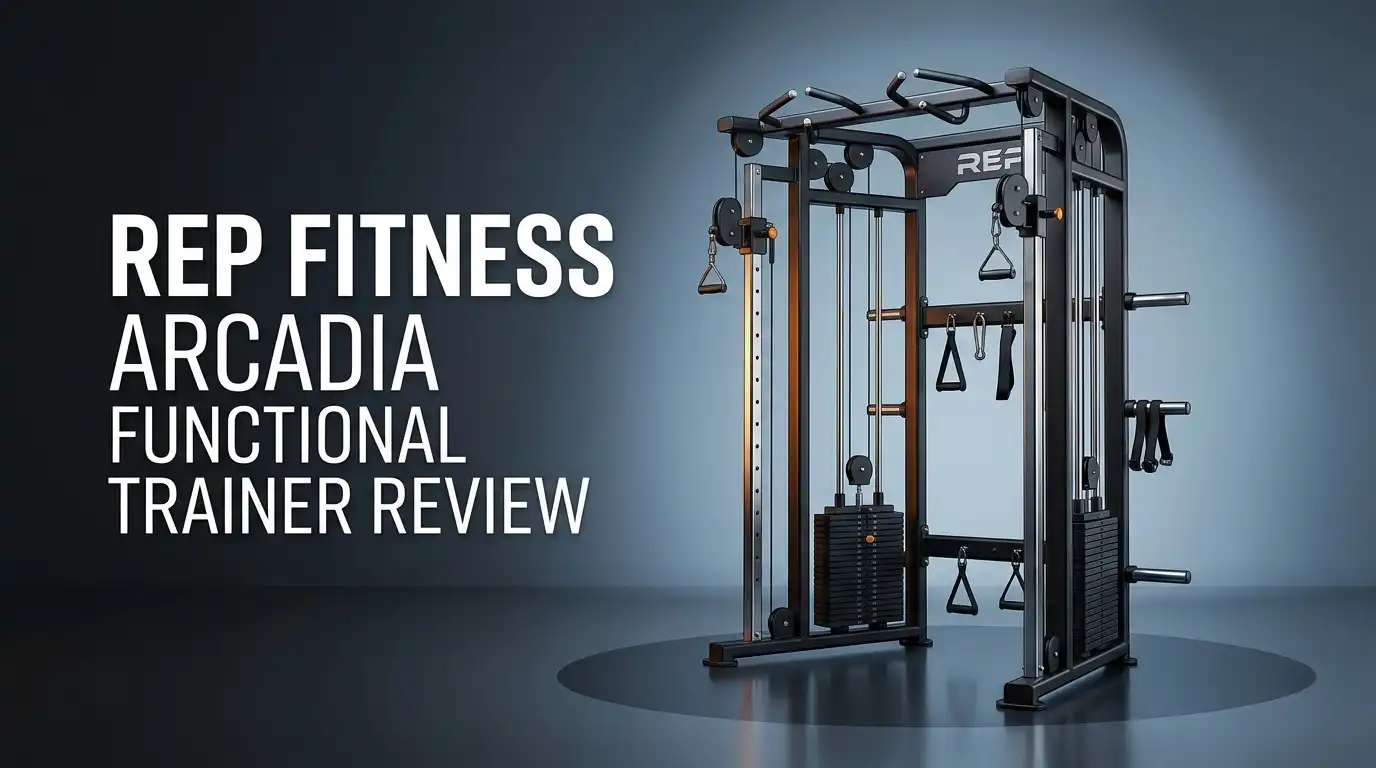
The result is a compact tower with two independent weight stacks, 32 cable height positions per upright, a multi grip pull up bar, integrated band pegs, and a rear pegboard for attachment storage.
It measures about 35.8 inches deep, 55.3 inches wide, and 80.8 inches tall. You can flip the pull up bar during assembly to drop the height to 78 inches for low ceilings.
Two knurled steel D handles come included. They are solid, not the squishy foam type that ships with cheap machines.
Unboxing and First Impressions
Your Arcadia arrives by freight on a wooden pallet. Plan for that. The driver will drop it at the curb unless you ask nicely, and the boxes are heavy enough that dragging them alone is a bad idea.
Opening the crate is satisfying. Two large upright sections come already welded and partly assembled, which removes a huge amount of fiddly work. The powder coat finish looks better in person than in product photos. It has a subtle metallic sheen rather than the flat black texture most gym gear wears.
The smaller boxes hold pulleys, cables, hardware bags and the pegboard hooks. REP labels the hardware clearly. The first thing most people notice is weight. These parts feel dense and expensive, not hollow.
Build Quality and Materials
This is where the Arcadia separates itself from budget cable towers. The uprights use stainless steel with laser cut numbers beside each hole. Stainless resists corrosion in humid garages and avoids the slick, oily feel of chrome.
The trolleys are a scaled down version of the system REP built for its Ares rack attachment. They glide. They also rotate side to side, so you can angle a cable away from the machine or let two people train at once on opposite stacks. Oversized pop pins with heavy springs snap into place with a firm, tactile click.
Aluminum pulleys and brass bushings handle the cable path. Bushing quality influences cable feel as much as pulley material does, and REP clearly spent money here. Expert testers rated construction 4.5 out of 5.
Top 3 Alternative for REP Fitness Arcadia Functional Trainer

Last update on 2026-10-31 / Affiliate links / Images from Amazon Product Advertising API
Titan Fitness Functional Trainer

Last update on 2026-10-31 / Affiliate links / Images from Amazon Product Advertising API
Inspire Series FT2 PRO Smith Functional Trainer

Last update on 2026-10-31 / Affiliate links / Images from Amazon Product Advertising API
Titan Fitness Plate Loaded Functional Trainer
Weight Stacks and Pulley Ratio Explained
This part confuses new buyers more than anything else. The Arcadia ships with two 170 pound stacks. The pulley ratio is 2:1. You feel roughly half the number you select on the pin. Set the pin at 170 and your hand feels about 85 pounds.
That ratio is standard on functional trainers. It buys you longer cable travel, which matters for pulldowns, overhead presses and full range flyes. The Arcadia gives you 81 inches of cable travel.
Minimum usable weight is 10 pounds per stack, which is low enough for rotator cuff work and rehab sets. There is also a clever five pound micro weight with its own pin that slides down to fine tune your load. It auto locks when pushed back up. Small detail, big daily convenience.
Cable Positions and Adjustability
Thirty two height positions per upright is generous. Many competing trainers offer half that. More positions mean you can dial in an exact angle for a decline fly, a low to high chop, or a face pull that sits perfectly at eye level.
Changing height is fast. You grab the knurled trolley handle, pull the pin, slide, release. The knurling here is a nice touch because your hands stay dry and grippy even mid workout.
Each hole has a laser cut number next to it. That makes repeating a setup easy when you train with a partner who uses different heights. Testers scored adjustability a perfect 5 out of 5. The band pegs on the base and headplate let you stack band tension up to a claimed 540 pounds of total resistance.
Assembly Experience: The Honest Version
Expect to lose an afternoon. Two people need about four hours. One person should not attempt this.
The good news is that the two welded upright sections do most of the structural work for you. You bolt them together using the pull up bar at the top and the pegboard at the rear. That creates a rigid frame quickly. Cable routing is the slow part. Threading cables through multiple pulleys takes patience and a careful read of the manual.
Some owners report minor instruction errors in one or two steps. Nothing that stops the build, but you may need to study the diagrams. Build it in the room where it will live. Moving an assembled Arcadia is not realistic without help.
Footprint and Space Planning
The Arcadia is marketed as compact, and compared to full cable crossover rigs it truly is. Still, it needs real space. Depth runs about 35.8 inches, width about 55.3 inches at the front feet, height about 80.8 inches standard.
Measure your ceiling first. At 80.8 inches tall you need clearance for the frame plus room to actually do pull ups. Inverting the multi grip bar drops you to 78 inches if you are tight.
You also need clear floor space in front of the machine. Cable work involves stepping out, lunging and rotating. Six to eight feet of open floor in front makes the machine far more usable. Testers gave footprint a 4.5 out of 5 rating, which is high for this category.
Attachments and Storage Pegboard
REP added a rear pegboard after users asked for one. It ships with four inch and six inch hooks that mount wherever you want them. You can hang ropes, ankle straps, lat bars and handles directly behind the machine.
This solves a problem most cable owners know well. Attachments end up on the floor, in a bin, or looped over a dumbbell. Keeping them at arm’s length changes how often you actually use them.
The included pair of knurled steel D handles covers most pressing, rowing and curling work. REP sells optional packages including a lat bar, ropes, ankle cuffs and straight bars. Any standard carabiner attachment from other brands works fine too, so you are not locked into one ecosystem.
Workout Feel and Smoothness
This is the Arcadia’s best quality. The cables move without grinding, catching or rattling. Reviewers who have tested more than a dozen functional trainers call this one of the smoothest they have used.
Why it matters: a rough pulley system pulls your attention away from the muscle you are training. On the Arcadia you stop noticing the hardware. Flyes, pulldowns, rows, pull throughs and lateral raises all feel consistent through the full range.
The rotating trolleys help a lot during crossover movements and single arm work. Stability is excellent. The frame does not rock or walk under heavy loads, even during aggressive rows. Smoothness and stability both scored a perfect 5 out of 5 in hands on testing, and that matches owner feedback.
What the Arcadia Does Not Do Well
Every honest review needs this section. Here are the real shortcomings.
Usable width between the uprights is only about 42 inches. That is narrower than full size trainers. Wide chest flyes and cable crossover curls feel restricted, especially for lifters over six feet tall. This is the most common complaint in owner reviews.
Assembly is long. Four hours with a helper is a genuine commitment, and a couple of manual steps are unclear.
Starting weight of 10 pounds per side is low but not zero, which still limits some light rehab protocols.
It also does not replace a power rack. There is no barbell catch, no safety arms, no squat capability. If you only have room for one machine and you want to squat or bench heavy with a bar, the Arcadia is the wrong purchase.
Pros and Cons of the REP Arcadia
Pros
- Exceptionally smooth cable feel thanks to aluminum pulleys and brass bushings
- Compact footprint fits most garages and basements without dominating the room
- 32 cable positions per upright with clear laser cut numbers
- Lifetime frame warranty from a brand with a strong reputation
- Free shipping and financing options through Affirm or ShopPay
- Rear pegboard storage keeps attachments organized and reachable
- Stainless steel uprights resist rust in humid spaces
- Five pound micro weight allows precise load jumps
Cons
- Only about 42 inches of usable width between uprights, which limits wide flyes
- Assembly takes roughly four hours and requires two people
- No barbell or squat rack function at all
- Weight stack upgrade costs an extra $325 or so
- Return shipping fees apply and a 15 percent restocking fee may hit incomplete returns
- Some instruction steps contain errors
- Heavy freight delivery requires planning
Arcadia vs Arcadia Max: Which One Fits You
REP later released the Arcadia Max for buyers who want more room. The Max runs near $2,600, stands about 87.6 inches tall, and spreads roughly 75.5 inches wide at the feet.
The Max carries 220 pound stacks upgradeable to 270 pounds, 36 cable positions instead of 32, a larger pegboard, and 93.4 inches of cable travel. Lifters around six feet four and taller strongly prefer the Max. One verified owner at six feet six said the Max was mandatory for him.
For everyone else, the standard Arcadia wins on value. The $600 gap buys attachments, a bench, or a bar. Expert testers still rate the regular Arcadia as the better value of the two, even while praising the Max’s construction.
Price, Warranty and Customer Support
The Arcadia sits around $1,999 with free shipping, which is rare on a machine this heavy. The 220 pound stack upgrade adds about $325. Attachment packages run from roughly $175 to $340 depending on the bundle.
Warranty coverage is lifetime on the frame, structural welds and weight stack plates. Pop pins, pulleys, bushings, plastic inserts, cables and hardware carry one year. The lifetime term applies to the original purchaser only and excludes normal wear.
Returns run 30 days. You pay return shipping, and a 15 percent restocking fee applies if the item comes back incomplete or outside original packaging. Support is based in Colorado and reachable by phone, text, email or live chat during posted weekday and Saturday hours.
Who Should Buy the REP Arcadia
Buy it if you want one machine that trains your whole body in a small space. It suits lifters who care about cable quality, who already own a rack or bench, and who plan to keep this equipment for a decade.
It fits apartment gyms, basement gyms and shared garage spaces well. Anyone under about six feet two will find the width perfectly workable.
Skip it if your budget caps below $1,500, if you need squat and bench capability from the same unit, or if you want wide crossover room for bodybuilding chest work. Plate loaded fans should also look elsewhere, since stack machines carry a different cost structure and feel.
Final Verdict
The REP Arcadia earns its reputation. It delivers commercial grade smoothness, thoughtful engineering details, and a lifetime frame warranty at a price that competitors struggle to beat. Expert testers scored it 4.6 out of 5 overall, with perfect marks for versatility, smoothness and stability.
The flaws are real but narrow. Assembly is long. The space between uprights is tighter than full size machines. Neither issue affects daily training for most users once the build is done.
If you want the best value functional trainer in 2026, this is the one to beat. Taller lifters should spend the extra money on the Max. Everyone else can buy the standard Arcadia with confidence and spend the savings on attachments.
Frequently Asked Questions
How much weight does the REP Arcadia actually feel like?
The standard stacks hold 170 pounds each, but the 2:1 ratio means you feel about 85 pounds per side. The upgraded 220 pound stacks give you about 110 pounds of felt resistance per arm.
Can one person assemble the Arcadia?
No. REP recommends two people and roughly four hours. The welded upright sections are too heavy and awkward for solo handling.
Does the Arcadia replace a power rack?
It does not. There are no barbell catches or safety arms. You can do pull ups on the multi grip bar, but barbell squats and bench press require a separate rack.
What is the ceiling height requirement?
The machine stands 80.8 inches tall, or 78 inches with the pull up bar inverted. Add extra clearance above that if you plan to do pull ups.
Is the weight stack upgrade worth it?
For most people, no. Eighty five pounds of felt resistance per arm covers nearly all cable exercises. Advanced lifters doing heavy single arm rows or pulldowns may want the extra load.
Does REP ship outside the United States?
REP ships within the lower 48 states and Canada. International shipping is not offered.

Hi, I’m Sarah Hill — the founder and voice behind Heavy Lift Vault. I’m passionate about fitness, strength training, and health technology. I spend my time researching, testing, and reviewing workout equipment and health devices so you don’t have to guess. My goal is to deliver honest, detailed, and trustworthy reviews that help you invest wisely in your fitness journey.