WalkingPad R2 2-in-1 Treadmill with Handle Bar Review 2026: Worth Buying?
Most home treadmills ask for a full room. The WalkingPad R2 asks for a corner. This folding machine walks a strange line between a quiet under desk walking pad and a real running treadmill, and it does both without a permanent spot in your living room.
I spent weeks testing it, folding it, running on it, and listening for every squeak. Some things impressed me. Some things annoyed me.
This review covers the honest middle ground, including the parts the marketing pages skip. If you want steps during work hours and a jog at night, keep reading.
In a Nutshell:
- The R2 folds in half and almost disappears. The folded size drops to roughly 39 x 28 x 6 inches, so it slides under a sofa or bed. A standard running treadmill needs double the floor space, which makes this the strongest selling point by far.
- Two speed modes, one machine. Drop the handle bar and you get walking mode capped at 3.7 mph. Raise the handle bar and running mode unlocks up to 7.45 mph. That flexibility is rare at this size.
- The brushless motor runs quiet. It produces a low hum rather than a loud whine. Neighbors below you will likely stay happy, though the deck still thumps during running.
- The running deck is small. At 17.3 x 47.2 inches, tall users with long strides will feel cramped. This is a treadmill for short jogs, not marathon training.
- The handle bar is not a safety rail. It helps with balance and holds your phone. It will not stop a real fall, so skip this model if you have balance limits.
- Price sits around $599 to $699. That buys a lot of versatility, but it buys fewer features than a full size treadmill at the same cost.
What Is the WalkingPad R2 2-in-1 Treadmill?

Last update on 2026-11-01 / Affiliate links / Images from Amazon Product Advertising API
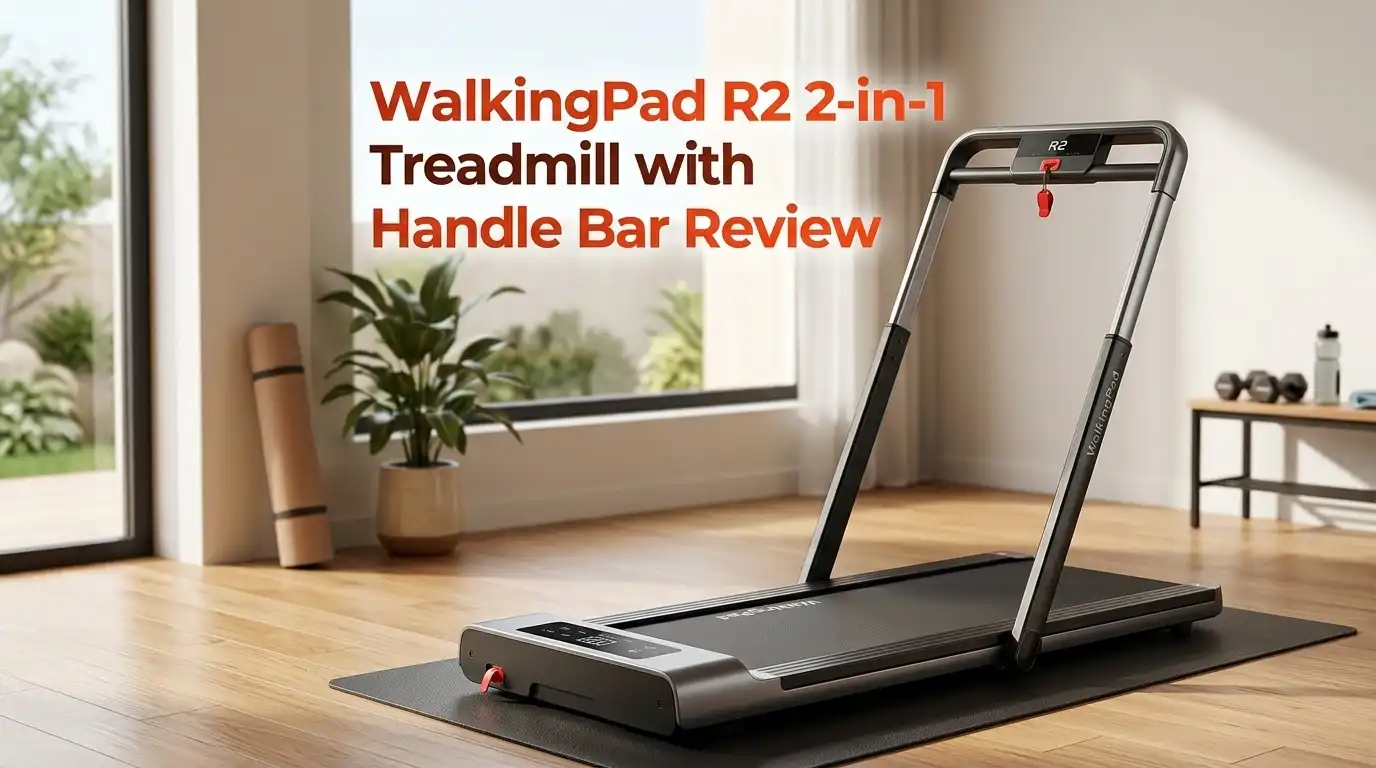
The WalkingPad R2 is a folding treadmill made by KingSmith. It targets people who want exercise at home but refuse to give up a room for it. The machine works in two ways. With the handle bar folded flat, it becomes an under desk walking pad. With the handle bar raised, it becomes a compact running treadmill.
The deck folds in half across the middle. That single design choice separates the R2 from flat walking pads that stay long even when stored. The whole unit arrives fully assembled. You unfold it, plug it in, and start moving.
Think of it as a treadmill that respects your square footage. It solves a space problem first and a fitness problem second. That order matters when you judge it.
Unboxing Experience: What Arrives at Your Door
The box is heavy. The R2 weighs 81 pounds, and the packaging pushes that past 90. Plan for two people or a smooth floor and a dolly. The delivery driver will likely leave it at your door, so clear a path before it arrives.
Inside, the treadmill sits folded in dense foam. There is no assembly. You get the machine, a remote control, a safety key, a power cord, an Allen wrench for belt tension, and a short manual. That is the entire kit.
The first unfold feels stiff. The handle bar clasps need a firm push, and the knobs at the base require a full turn. The deck also makes a loud cracking sound the first time it opens. That noise is just lubricant releasing between belt and deck. It startled me. It did no damage.
Key Specifications at a Glance
Numbers tell the real story here. The open footprint measures 57.1 x 28.3 x 40.6 inches. Folded, it shrinks to 39.4 x 28.3 x 6.3 inches. The running surface measures 17.3 x 47.2 inches.
The brushless motor is rated at 3.75 HP peak by the brand. Speed runs from 1.0 to 7.45 mph in running mode and tops out at 3.7 mph in walking mode. Maximum user weight sits at 242 pounds. Product weight is 81 pounds. The warranty covers one year.
The LED display shows time, speed, distance, calories, and steps. Bluetooth connects to the KS Fit app. There is no incline on this model. That absence matters if you want hill training, and it is the clearest gap in the spec sheet.
Top 3 Alternative for WalkingPad R2 2-in-1 Treadmill

Last update on 2026-11-02 / Affiliate links / Images from Amazon Product Advertising API
WALKINGPAD X21 Foldable Treadmill Smart Double Folding Walking Pad

Last update on 2026-11-02 / Affiliate links / Images from Amazon Product Advertising API
Goplus 2 in 1 Folding Treadmill 2.25HP Superfit Under Desk Electric Treadmill

Last update on 2026-11-02 / Affiliate links / Images from Amazon Product Advertising API
UREVO Strol 2E Smart 2 in 1 Folding Treadmill with Safety Handle
Build Quality and Materials
The frame uses aluminum alloy, and it feels solid under your feet. The deck sits low to the ground, which adds natural stability. Walking on it produces no wobble. Running at full speed produces a little flex, but nothing alarming.
The handle bar is the weak point. It adjusts for height and locks with clasps, yet it never feels like a gym grade rail. Lean hard on it and you feel movement. Treat it as a guide, not a support.
The side foot rails are narrow. Rubber dots add grip, but my running shoes hung over the edges. Stepping off mid workout takes care. The low deck height saves you here, since you can simply step onto the floor instead.
Walking Mode and FootSense Technology
Fold the handle bar down and the R2 enters walking mode. Speed caps at 3.7 mph, which suits desk work perfectly. This is where the machine shines.
You get two options. Manual mode lets you set speed with the remote. Auto mode uses FootSense, which reads your foot position and adjusts speed on its own. Walk forward and it speeds up. Drift back and it slows down.
FootSense sounds clever and feels awkward. It took me several sessions to stop fighting it. During focused work, small body shifts triggered speed changes I did not want. I switched to manual mode and never looked back. Most desk walkers will do the same. The feature works, but it solves a problem few people actually have.
Running Mode: Can You Really Run on It?
Yes, with limits. Raise the handle bar and the speed ceiling jumps to 7.45 mph. That pace equals roughly an eight minute mile, which covers most casual runners.
The belt holds speed without stuttering. The motor stays composed. But the deck is short at 47.2 inches. Runners over six feet tall will clip the front or back. Shorter strides and a higher cadence fix this, and aiming for around 180 steps per minute helps a lot.
Cushioning is firm. The deck sits close to the floor, so there is little room for shock absorption. My knees noticed after twenty minutes. Short jogs feel fine. Long runs do not. Use this for a quick three mile effort, not for half marathon training blocks.
Handle Bar Design and Stability
The handle bar does three jobs. It unlocks running mode, it holds your phone, and it folds into a carry handle. That triple duty is smart engineering.
Height adjusts through clasps at the sides. Taller users can raise it. Shorter users can drop it. The adjustment mechanism sticks sometimes and needs a wiggle to release, which feels cheap on a machine at this price.
The console sits at the top of the bar. A small compartment stores the safety key and holds a phone at a readable angle. It will not fit a tablet. Grip comfort is average. The bar is thin, and there is no padding. For balance checks and quick support it works well enough.
Noise Levels and Apartment Friendliness
The brushless motor is genuinely quiet. During walking at 2.5 mph, I held phone calls with no complaints from the other end. The sound reads as a soft hum rather than mechanical grinding.
Running changes the equation. Your footfalls make more noise than the motor. The deck sits on a hard floor, so impact transfers downward. Upstairs neighbors in apartments should expect feedback during running sessions.
A treadmill mat solves most of this. It absorbs impact, cuts vibration, and protects your floor from the deck slamming during unfolding. I consider a mat close to mandatory. Budget an extra forty dollars for one. The machine also lands loudly when you set it down, which no amount of care seems to prevent.
Folding, Storage and Portability
This is the headline feature. The deck folds in half, the handle bar drops flat, and the R2 becomes a near square slab roughly six inches thick. It slides under a bed, behind a door, or into a closet.
Two transport wheels help you move it. On hard floors, rolling is easy. On carpet, it fights back. At 81 pounds, lifting is possible for most adults but not pleasant.
The folding hinge draws the most complaints from long term owners. Some users report belt misalignment developing near the fold after months of heavy use. Keeping the belt properly tensioned with the included Allen wrench reduces that risk. Fold it gently rather than letting it drop.
The KS Fit App and Display
The LED screen sits on the motor hood at the front. It shows time, speed, distance, calories, and steps in high contrast numbers. Reading it while walking is easy. Reading it while running is harder, since your eyes bounce.
Three buttons sit beside the screen for power, manual mode, and auto mode. The included remote handles speed changes and start or stop commands.
The KS Fit app adds very little. It mirrors your metrics, logs distance, and controls speed through Bluetooth. Connection happens fast. Disconnection also happens fast. Mine dropped several times per week. There are no guided workouts, no training programs, and no video content. Treat the app as optional.
Pros and Cons of the WalkingPad R2
Pros
- The folded footprint is genuinely tiny, taking under eight square feet of floor space when stored away.
- Two modes in one machine cover both desk walking and real running without buying separate equipment.
- The brushless motor stays quiet during walking, which makes it practical for shared homes and work calls.
- It arrives fully assembled, so setup takes minutes rather than an afternoon of bolts and brackets.
- The 7.45 mph top speed beats almost every other folding walking pad on the market.
- The handle bar doubles as a phone holder and a carry handle, which saves you buying accessories.
Cons
- The 47.2 inch deck is too short for tall runners with long strides.
- Cushioning is firm, so joints take more impact than on a full size treadmill.
- The handle bar wobbles and will not prevent a genuine fall.
- Side foot rails are narrow and awkward to stand on mid workout.
- The KS Fit app disconnects often and offers no real training content.
- There is no incline function at all.
- The 242 pound weight limit rules out heavier users.
What the WalkingPad R2 Does Not Do Well
Let me be blunt about the failures. This machine is not a replacement for a proper running treadmill. If you run more than fifteen miles per week, the short deck and firm surface will frustrate you within a month.
The belt needs more maintenance than average. Running speeds stretch the belt faster, and the fold line adds a stress point. Expect to use the Allen wrench every few months. Owners who skip this maintenance report belt drift and slipping.
The weight limit of 242 pounds is low for a machine marketed at runners. The one year warranty is also thin given the price.
Customer service responses from the brand can be slow. Several owners describe long waits for replacement parts.
Who Should Buy the WalkingPad R2?
This treadmill fits a specific person. Apartment dwellers and renters get the most value. If storage space drives your decision, nothing else at this price folds as small while still offering running speeds.
Remote workers with standing desks are the second strong fit. The walking mode and quiet motor suit a full workday of light movement.
Casual runners who log short easy miles will be satisfied. Serious runners will not. Buy a full size treadmill instead if running is your main sport.
Skip this model if you weigh over 240 pounds, if you stand over six feet two inches, if you need incline training, or if balance issues mean you depend on a sturdy rail.
Price and Value in 2026
Last update on 2026-11-01 / Affiliate links / Images from Amazon Product Advertising API
The R2 typically sells between $599 and $699, with the brand site often running sales near $599. Amazon pricing hovers around $699 depending on stock.
At that figure, you are paying a premium for the folding mechanism. A standard folding treadmill at $699 gives you a longer deck, incline, and better cushioning. It also gives you a machine that dominates your room.
The R2 charges you for convenience, not performance. That trade works if space is your constraint. It fails if space is not.
Watch for Black Friday and Prime Day drops, since the brand discounts aggressively. Under $550, the value case becomes strong. At full retail, the gap narrows against the competition.
Final Verdict: Is the WalkingPad R2 Worth It?
The WalkingPad R2 does one thing better than almost any competitor. It folds down to nothing while still letting you run. That alone justifies its existence.
The experience is good, not great. The motor impresses. The build feels solid at walking speeds. The quiet operation is real. But the short deck, the firm surface, the wobbly handle bar, and the forgettable app keep it from being outstanding.
I would buy it for a small apartment without hesitation. I would not buy it for a basement gym with room to spare.
Score it around 8 out of 10 for small space users and around 6 out of 10 for everyone else. Know which group you belong to before you order.
Frequently Asked Questions
Can you actually run on the WalkingPad R2?
Yes. Raise the handle bar and the speed unlocks to 7.45 mph. The deck measures 47.2 inches, so runners under six feet will be comfortable. Taller runners should shorten their stride and raise their cadence.
Does the WalkingPad R2 have incline?
No. The R2 offers no incline function at all. If hill training matters to you, look at models like the UREVO Strol 2E Pro, which includes a powered incline.
How much weight can the WalkingPad R2 hold?
The stated maximum user weight is 242 pounds. Exceeding that limit risks motor strain and belt damage, and it may void your warranty.
Is the WalkingPad R2 quiet enough for apartments?
During walking, yes. The brushless motor produces a soft hum. During running, footfall impact becomes the louder factor. Place it on a treadmill mat to reduce vibration transfer to neighbors below.
Does it need assembly?
No. The R2 ships fully assembled. You unfold the deck, raise the handle bar, insert the safety key, and plug it in. Setup takes under ten minutes.
How do I maintain the belt?
Use the included Allen wrench to adjust tension at the rear of the deck. Check alignment monthly if you run on it. Lubricate the belt roughly every three months or according to the manual.
Does the WalkingPad R2 work with a standing desk?
Yes. Fold the handle bar flat and the unit sits low enough for most desks. Note that the deck is 28 inches wide, which is wider than slim walking pads, so measure your desk area first.
What is the warranty length?
The standard warranty covers one year on parts and the motor. Some retailers offer extended protection plans at checkout for an additional fee.

Hi, I’m Sarah Hill — the founder and voice behind Heavy Lift Vault. I’m passionate about fitness, strength training, and health technology. I spend my time researching, testing, and reviewing workout equipment and health devices so you don’t have to guess. My goal is to deliver honest, detailed, and trustworthy reviews that help you invest wisely in your fitness journey.