
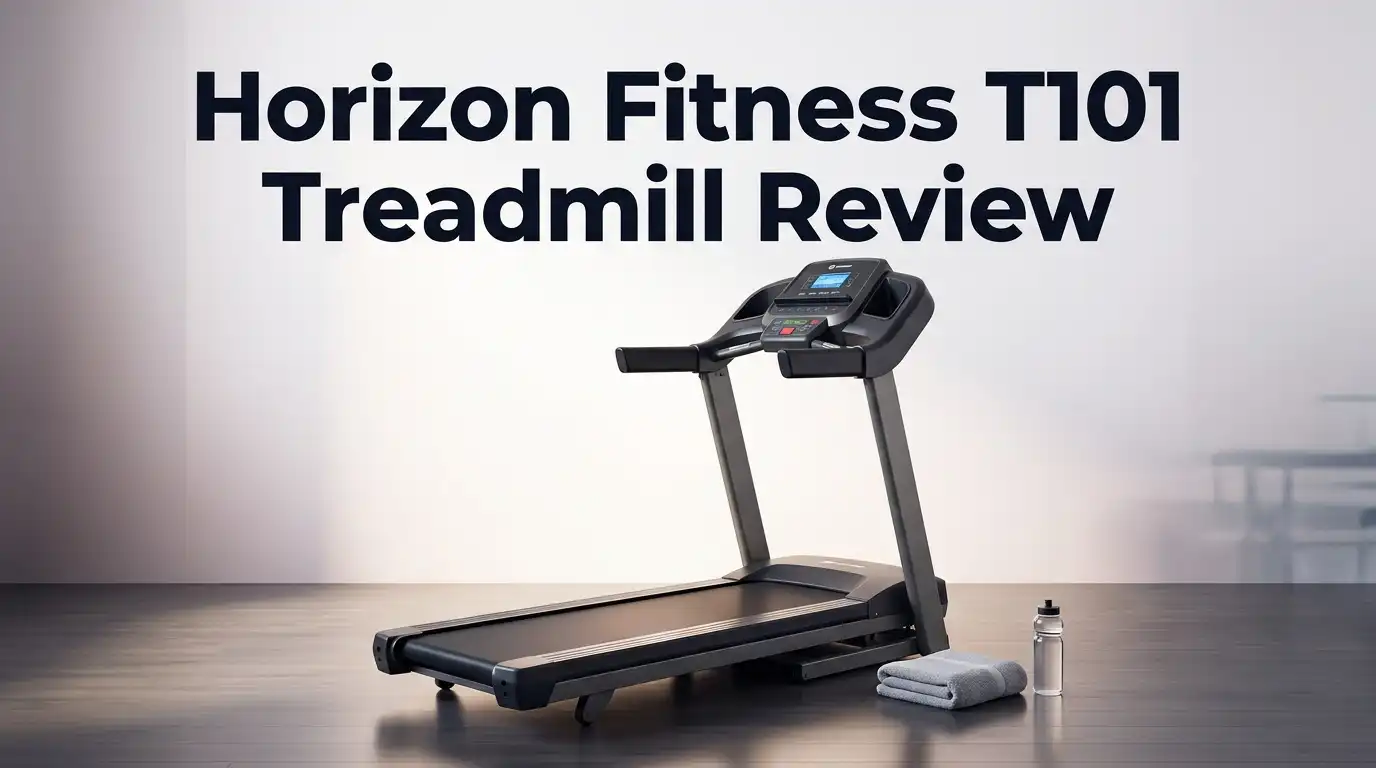
Horizon Fitness T101 Treadmill Review 2026: Worth Buying?
The Horizon T101 has quietly sold more units than almost any other home treadmill in its price class. It costs about $600 to $800, folds up, and carries a lifetime frame and motor warranty. That combination grabs attention fast. But cheap treadmills hide problems, and the T101 hides a few of its own.
I spent weeks walking, jogging, and sprinting on this machine. I unboxed it myself, bolted it together on my garage floor, and measured the belt with a tape.
This review covers the parts Horizon advertises and the parts it quietly skips. By the end you will know if the T101 fits your body, your room, and your training goals.
Key Takeaways
- The T101 is a walking treadmill first. The 2.5 horsepower motor and 55 inch belt handle walks, incline hikes, and light jogs well. Serious runners will outgrow it quickly.
- The warranty beats the price tag. Horizon covers the frame and motor for the lifetime of the original owner. Parts and labor get one year. Few machines near $600 offer this.
- It folds, but not flat. The deck lifts into a V shape and saves floor space. It still needs a dedicated corner, and the 180 pound weight makes moving it a two person job.
- The console stays simple on purpose. You get four blue LED windows, six built in programs, quick speed and incline buttons, dial controls on the handlebars, and Bluetooth speakers. No touchscreen and no forced subscription.
- Cushioning is average. Horizon markets a three zone system, but the deck feels firmer than pricier models. Runners will feel every step.
- Shake appears at higher speeds. The frame stays planted during walks. Push past 7 mph and you notice vibration through the handlebars.
Horizon Fitness T101 Treadmill


Last update on 2026-10-19 / Affiliate links / Images from Amazon Product Advertising API
The T101 sits at the entry point of Horizon’s lineup. Johnson Health Tech builds it, and that parent company also owns Matrix and Bowflex. You feel that manufacturing history in the small details.
Specs are easy to summarize. The frame holds 300 pounds of user weight. The motor pushes the belt from 0.5 mph to 10 mph. Incline climbs from 0 percent to 10 percent. The running surface measures 20 inches wide by 55 inches long. Folded dimensions shrink to roughly 46 inches long and 61 inches tall.
The machine weighs 180 pounds, which is light for a treadmill and heavy for a piece of furniture. Horizon ships it in one large box. The current 2026 version carries the Connect name because of its Bluetooth features.
Unboxing Experience and What Arrives
My delivery driver dropped a single cardboard crate in the driveway. It measured about five feet long and weighed close to 190 pounds with packaging. Do not try to carry it alone. I slid it across the floor on a moving blanket instead.
Inside, Horizon packs the machine in eight main pieces. The deck and motor housing come preassembled as one heavy unit. The two uprights, the console, the side covers, and the hardware bag sit in foam cutouts above it.
The hardware bag impressed me. Horizon includes a prelabeled wrench, an Allen key, and every bolt sorted into numbered pockets. Nothing was missing. One annoyance stands out though. Stickers cover the console, the handlebars, and the deck. I peeled off nine of them before the machine looked clean.
Assembly Time and Difficulty
Assembly took me 42 minutes working alone. A helper would cut that to about 25 minutes. The instruction booklet uses large line drawings with numbered steps, and the drawings match the real parts.
The hardest moment comes when you lift the uprights into place and hold them while threading the first bolt. Each upright uses three bolts per side. Have someone steady the post if you can.
Wiring is simple. Two ribbon cables run from the base into the console. They click together with no force. I did pinch one cable under the plastic cover on my first try, so route them carefully before tightening screws.
Horizon offers paid assembly service for around $150 to $300. If stairs stand between your driveway and your workout room, that fee buys real peace of mind.
Design, Frame, and Build Quality
The T101 uses a welded steel frame with plastic shrouds over the motor and side rails. It looks plain. All black, low profile, no flashy accents. That restraint helps it blend into a bedroom or office.
Handlebars are the standout feature. They carry a soft textured padding that feels borrowed from a machine twice the price. EKG pulse sensors sit inside the grips. Three bolts anchor each upright, so you can lean on the bars without any creaking.
The step up height measures just over 7 inches. That low deck makes boarding easy for older users and anyone with knee issues. Foot rails on each side are plastic but textured and wide enough to stand on safely.
Note that online photos sometimes show a front crossbar. The real machine has none.
Top 3 Alternative for Horizon Fitness T101 Treadmill

Last update on 2026-10-17 / Affiliate links / Images from Amazon Product Advertising API
NordicTrack T Series 10 Treadmill

Last update on 2026-10-17 / Affiliate links / Images from Amazon Product Advertising API
ProForm Carbon T7 Smart Treadmill

Last update on 2026-10-19 / Affiliate links / Images from Amazon Product Advertising API
XTERRA Fitness TRX3500 Folding Treadmill
Console, Display, and Button Layout
Four blue LED windows show your metrics. You see time, distance, calories, speed, incline, and heart rate. A toggle button cycles the display so you can view everything. The windows read clearly in a dark basement, which I appreciated during early morning sessions.
Quick keys line both sides of the console. Press 5 and the belt moves to 5 mph. Press 8 on the incline side and the deck lifts to 8 percent. This saves real time during intervals.
My favorite control is the dial. Each handlebar end holds a rotating wheel for speed or incline. The 2026 model recesses these dials deeper so your palm cannot bump them by accident.
The buttons sit flush rather than raised, which makes them harder to find by touch alone. Taller users also told me the console sits a bit low.
Motor Power and Real Speed Performance
Horizon no longer prints the horsepower figure on its website. The motor under the hood is rated at 2.5 horsepower. For walking at 2 mph to 4 mph, that rating is plenty. The belt never hesitated under my weight, even at full incline.
Running is a different story. Most trainers suggest 3.0 horsepower for daily running. The T101 tops out at 10 mph, so you can sprint, but the motor works hard doing it.
Acceleration is slow. Going from 0.5 mph to the 10 mph ceiling took 32 seconds in my test. Older Horizon models felt snappier. The upside is a smooth, gradual ramp that never jerks your stride. Incline moves faster, hitting 10 percent in roughly 16 seconds.
Deck Size, Belt, and Cushioning Feel
I measured the belt at 19.5 inches wide rather than the listed 20 inches. The difference is small. Length matters more. At 55 inches, the deck runs five inches shorter than most running treadmills.
Walkers and joggers under 6 feet tall will find that length fine. Taller runners with long strides will feel the back roller approaching. If you plan to run 7 mph or faster for long sessions, measure your stride first.
The deck board itself is three quarters of an inch thick, which matches industry norms for home machines. Cushioning uses two shock types across three zones.
Honest assessment: the surface feels firmer than the marketing implies. It beats concrete by a wide margin and loses to any $1,500 treadmill.
Incline Range and Hill Workouts
The T101 climbs from 0 percent to 10 percent. I measured the top setting at 9.6 percent, which is accurate enough to trust your calorie numbers.
Ten percent is a meaningful hill. At 3 mph on that grade, my heart rate climbed into zone three within four minutes. Walkers who want intensity without impact should use incline instead of speed.
The incline motor is quiet and quick. Interval programs that alternate flat and hill segments run smoothly with no lag between commands.
There is no decline function. Machines with negative grade cost considerably more, so this absence is expected at this price. The deck also sits 13 inches high at full incline, so check your ceiling. Allow about 18 inches of clearance above the tallest user in your home.
Bluetooth, Apps, and Built In Speakers
The Connect version supports FTMS, the open protocol that links equipment to fitness apps. JRNY, Peloton, Zwift, Kinomap, and Nike Run Club all pair without drama. Kinomap can even drive the incline during scenic routes.
No subscription is required. The six onboard programs are free forever, and three of them offer ten difficulty levels. That independence is rare in 2026.
The Bluetooth speakers surprised me. They get loud and stay clear, even with the belt running at 6 mph. You control volume from your phone since the console has no volume keys.
One limitation deserves attention. Bluetooth runs in either app mode or heart rate mode, never both. Pair a chest strap and you lose the app connection until you switch back.
Folding, Moving, and Storage Reality
Folding uses a hydraulic assist. Lift the deck until it latches, and the machine settles into a V shape. The footprint drops from 70.5 inches to about 46 inches of floor length.
To unfold, tap the kick release with your foot. A damper lowers the deck slowly. The deck wobbles noticeably as it drops, and that wobble is the clearest sign of the budget price.
Front transport wheels let you tilt and roll the machine. At 180 pounds it is lighter than most treadmills, yet still awkward. Expect to walk it carefully through doorways.
The V shape fold does not stand fully upright, so you cannot slide it behind a door or into a narrow closet. Plan for a permanent corner.
Noise Level and Apartment Friendliness
Horizon calls the T101 ultra quiet. My meter tells a softer story. At 3 mph the machine registered 57 decibels. At the full 10 mph it reached 70 decibels. Those readings came with nobody on the belt.
Add footfalls and the number rises. Walking stayed conversational. Running created a rhythmic thump that traveled through the floor.
For a ground floor room or a basement, the T101 works fine. For a second floor apartment above a light sleeper, I would hesitate. A quality rubber treadmill mat reduces both noise and vibration noticeably.
The fan is loud in the best way. Three speeds, strong airflow, and good aim at your chest. It genuinely cools you during longer walks.
What the Horizon T101 Does Not Do Well
Every honest review names the weak spots. Here are mine after extended testing.
The frame shakes above 7 mph. Vibration travels into the handlebars and the console flexes slightly. You will not fall off, but you will notice.
Cushioning underdelivers. The three zone system softens impact less than Horizon’s own running models. Knees that already complain may still complain here.
The console is dated. LED windows work, yet they look a decade old next to touchscreen rivals at $900.
Folding feels flimsy. The wobble during unfolding bothered me every time. Shipping and assembly add friction. The sticker removal is a small irritation, and the 180 pound box demands help. Finally, parts coverage lasts only one year.
Pros and Cons of the Horizon T101
Pros
- Lifetime frame and motor warranty that covers the original owner, not just the machine’s service life
- Price around $600 to $800 undercuts nearly every comparable folding treadmill
- Six free onboard programs with no subscription requirement at any point
- FTMS compatibility with JRNY, Peloton, Zwift, and Kinomap
- Quick dial speed and incline controls on both handlebars
- Two tablet racks and two cup holders for real convenience
- Low 7 inch step up height suits older users and sore knees
- Accurate incline measurement up to 9.6 percent
- Strong three speed cooling fan and clear Bluetooth speakers
- Compact 70.5 inch footprint that folds to roughly 46 inches
Cons
- 2.5 horsepower motor falls short for daily running
- 55 inch belt is short for tall runners
- Deck cushioning feels firm compared to pricier models
- Frame vibrates above 7 mph
- Folding and unfolding motion wobbles
- Console sits low for users over 6 feet
- No touchscreen and no streaming video
- Bluetooth cannot run an app and a heart rate strap together
- Parts and labor warranty covers only one year
- Slow 32 second acceleration to top speed
Who Should Buy the T101 in 2026
Buy this treadmill if you walk. Daily step counters, incline hikers, post injury rehab users, and work from home pacers will love it. The low deck, accurate incline, and quiet motor fit that purpose exactly.
Buy it also if you hate subscriptions. The T101 works completely offline with six free programs. No monthly fee ever appears.
Buy it if your budget stops near $700 and you still want real warranty protection. Nothing else in that range offers lifetime frame and motor coverage.
Skip it if you train for a marathon. Runners logging 20 miles a week deserve a 3.0 horsepower motor and a 60 inch belt. Skip it if you want Netflix on a screen. Skip it if you are over 6 foot 3, because the console height and belt length will frustrate you.
Price, Warranty, and Overall Value
List price sits at $999, but street pricing hovers between $599 and $799 across most of 2026. Watch for seasonal discounts in January and again around Black Friday.
The warranty carries real weight. Horizon covers the frame and motor for the lifetime of the original owner, and the company states that clearly rather than hiding behind vague language. Coverage is not transferable if you sell the machine.
Parts and labor get 12 months. That is standard for the category, though two or three years would feel better.
Value is where the T101 wins. You pay walking pad money and receive a real steel framed treadmill with incline, apps, and a lifetime motor promise. That math is hard to argue with.
Final Verdict on the Horizon T101
Last update on 2026-10-19 / Affiliate links / Images from Amazon Product Advertising API
The Horizon T101 earns a solid recommendation with clear boundaries. As a walking and light jogging treadmill, it is one of the smartest purchases in home fitness. The build quality exceeds its price, the controls are genuinely thoughtful, and the warranty removes the usual budget treadmill anxiety.
As a running treadmill, it falls short. The motor, belt length, and cushioning all point toward moderate use rather than hard training.
My rating lands at 4 out of 5 for walkers and 3 out of 5 for runners. Match the machine to your actual habits and you will stay happy for years. Buy it for steps, hills, and consistency. Look elsewhere for speed work.
Frequently Asked Questions
Is the Horizon T101 good for running?
It can handle running up to 10 mph, but the 2.5 horsepower motor and 55 inch belt suit walking and light jogging better. Runners training daily should choose a model with a 3.0 horsepower motor and a 60 inch deck.
How much weight can the T101 hold?
The frame supports users up to 300 pounds. Build quality feels confident at that limit, though heavier users may notice more flex in the deck.
Does the T101 need a subscription?
No. Six training programs live on the console and cost nothing. Apps like JRNY, Peloton, and Zwift pair through Bluetooth if you want them, but they stay completely optional.
How long does assembly take?
Expect 25 to 45 minutes. Horizon ships the machine in eight parts with sorted hardware and clear drawings. A second person makes lifting the uprights much easier.
Can I fold the T101 flat against a wall?
No. The deck folds into a V shape rather than standing upright. It saves roughly 24 inches of floor length, so you still need a dedicated spot.
Is the T101 quiet enough for an apartment?
It measures 57 decibels while walking and 70 decibels at top speed. Walking upstairs is usually fine with a mat underneath. Running above a neighbor will likely be heard.
What is the difference between the T101 and T101 Connect?
The Connect version adds Bluetooth for fitness apps, speakers, and an updated console with recessed dials. The core frame, motor, and deck remain the same.

Hi, I’m Sarah Hill — the founder and voice behind Heavy Lift Vault. I’m passionate about fitness, strength training, and health technology. I spend my time researching, testing, and reviewing workout equipment and health devices so you don’t have to guess. My goal is to deliver honest, detailed, and trustworthy reviews that help you invest wisely in your fitness journey.


