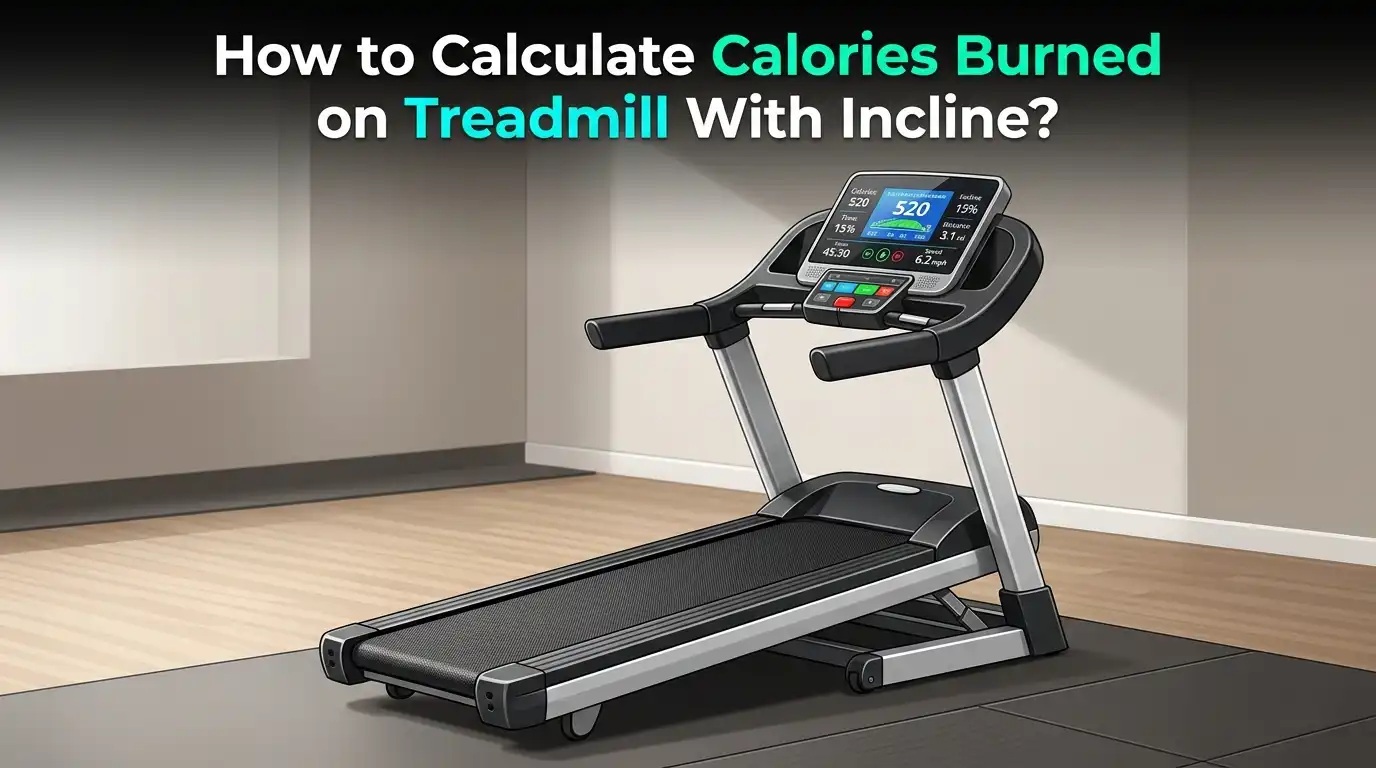
How to Calculate Calories Burned on Treadmill With Incline?
You just finished a 30 minute incline walk on the treadmill. The screen says you burned 400 calories. But did you really?
The truth is, most treadmill displays overestimate calorie burn by 15 to 20 percent, and some overshoot by as much as 42 percent. That is a massive gap if you rely on those numbers to guide your eating or track your weight loss progress.
Incline adds a powerful calorie boosting effect to any treadmill workout. A 5% grade can increase your energy output by 20 to 50 percent compared to flat walking at the same speed. But your treadmill probably does a poor job of accounting for that extra effort. It might ignore your body weight, your fitness level, and even the incline itself.
In a Nutshell
- Your treadmill’s calorie display is a rough estimate at best. It uses a generic formula that often ignores your body weight, age, sex, and fitness level. You can get a much more accurate number by using one of the methods in this guide.
- Body weight is the single biggest factor in calorie burn. A 200 pound person burns significantly more calories than a 130 pound person at the same speed and incline. Any calculation that skips your weight will produce an unreliable number.
- Incline is a serious calorie multiplier. Even a small 3 to 5 percent grade can boost your calorie burn by 20 to 50 percent compared to walking flat. A 10 percent incline can push your calorie output close to what jogging on a flat surface would demand.
- The MET formula is the simplest accurate method. It uses a standardized energy value for your activity, your weight in kilograms, and your workout time. The calculation takes about 30 seconds and gives you a solid baseline number.
- Heart rate data improves accuracy further. If you wear a chest strap or a well calibrated fitness watch, heart rate based formulas can account for your personal fitness level. A Stanford study found that most fitness trackers measure heart rate within 5 percent accuracy, though their calorie estimates still carry error.
- Holding the handrails cancels out much of the incline benefit. Research shows that gripping the rails at steep inclines can reduce your actual calorie burn by 20 to 25 percent. If you must hold on, you should lower the incline or speed to a level you can maintain hands free.
Why Your Treadmill Screen Cannot Be Trusted
Most treadmill consoles rely on a basic algorithm built around speed and time. Some models let you enter your body weight, which helps, but they still skip important variables like age, sex, and cardiovascular fitness. The result is a one size fits all estimate that works for almost nobody.
A study referenced by the Journal of Sports Medicine found that cardio machines overestimate calorie burn by an average of 13 percent. Some machines tested in the study were off by more than 40 percent. That means if your treadmill says you burned 500 calories, the real number could be closer to 350.
This error compounds over time. If you eat back 150 extra calories per day based on inflated treadmill readings, that adds up to over 1,000 extra calories per week. Over a month, that is enough to stall weight loss entirely. Understanding why the screen lies is the first step to fixing the problem.
What You Need Before You Start Calculating
You do not need lab equipment to get a better calorie estimate. A few basic data points will dramatically improve your accuracy. Gather your current body weight in pounds or kilograms before your next workout.
You will also need the treadmill speed (in mph or km/h), the incline percentage, and the total workout duration in minutes. If you have a heart rate monitor, grab that too. A chest strap sensor gives more reliable readings than a wrist based optical tracker.
A smartphone calculator or a simple spreadsheet is all you need to run the numbers. You can also use free online treadmill calorie calculators, but understanding the formulas yourself lets you spot errors and adjust for your own situation.
Understanding MET Values for Treadmill Exercise
MET stands for Metabolic Equivalent of Task. It measures how much energy an activity requires compared to sitting still. Sitting quietly equals 1 MET. Walking briskly at 3.5 mph equals about 4.3 METs. Running at 6 mph equals roughly 10 METs.
The Compendium of Physical Activities, maintained by Arizona State University, publishes standardized MET values for hundreds of exercises. These values come from controlled research, not from treadmill manufacturers. Here are some common flat treadmill MET values: walking at 2.0 mph is 2.8 METs, walking at 3.0 mph is 3.5 METs, jogging at 5.0 mph is 8.3 METs, and running at 7.5 mph is 12.3 METs.
Incline changes MET values significantly. Walking at 3.0 mph on a 5% incline carries a MET value of about 4.8, compared to 3.5 on flat ground. Walking at 3.5 mph on a 10% grade jumps to about 8.3 METs, which rivals jogging on a flat surface.
Pros of the MET method: Simple, fast, and backed by extensive research data.
Cons of the MET method: Does not account for individual fitness level or heart rate response.
The Basic MET Calorie Formula Step by Step
The MET calorie formula is straightforward. Multiply the MET value by your body weight in kilograms and then by the workout duration in hours. The result is your estimated calorie burn.
Formula: Calories Burned = MET x Weight (kg) x Time (hours)
To convert pounds to kilograms, divide your weight by 2.205. For example, 170 pounds divided by 2.205 equals 77.1 kilograms.
Here is a real example. A 170 pound (77.1 kg) person walks at 3.5 mph on a flat treadmill for 45 minutes. The MET value for 3.5 mph flat walking is 4.3. The time is 0.75 hours. The calculation is: 4.3 x 77.1 x 0.75 = 248 calories. Compare that to a typical treadmill display, which might show anywhere from 220 to 300 depending on the brand and model.
How to Add Incline to Your Calorie Calculation
Incline forces your body to work against gravity with every step. Your glutes, hamstrings, and calves engage more intensely, and your heart rate rises to deliver more oxygen. This means you burn more calories per minute than you would on a flat surface at the same speed.
The simplest way to account for incline is to use an incline correction multiplier. Based on ACSM research and exercise physiology data, here are approximate increases over flat ground calorie burn: a 1% incline adds about 3 to 4 percent, a 3% incline adds about 10 to 12 percent, a 5% incline adds 18 to 22 percent, an 8% incline adds 28 to 35 percent, a 10% incline adds 35 to 45 percent, and a 15% incline adds 55 to 65 percent.
Apply this multiplier to your flat ground MET calculation. Using the previous example of 248 calories at 3.5 mph, adding a 5% incline gives you: 248 x 1.20 = 298 calories. That is 50 extra calories from the same workout duration just by raising the belt angle.
Pros of the incline correction method: Quick and easy to apply on top of the MET formula.
Cons of the incline correction method: Multipliers are approximate averages and may vary based on stride length and body mechanics.
The ACSM Metabolic Equation for Treadmill Walking
The American College of Sports Medicine developed a more precise formula that breaks treadmill energy cost into three parts: resting cost, horizontal cost, and vertical (grade) cost. This equation is used in clinical exercise testing and provides one of the most accurate non lab estimates available.
ACSM Walking Equation:
VO2 (ml/kg/min) = (0.1 x speed) + (1.8 x speed x grade) + 3.5
Speed must be in meters per minute (multiply mph by 26.8). Grade is expressed as a decimal (5% becomes 0.05). The result is oxygen consumption in ml/kg/min. To convert VO2 to calories, divide by 3.5 to get METs, then use the MET formula above.
Here is an example. A person walks at 3.0 mph (80.4 m/min) on a 6% grade. VO2 = (0.1 x 80.4) + (1.8 x 80.4 x 0.06) + 3.5 = 8.04 + 8.68 + 3.5 = 20.22 ml/kg/min. Dividing by 3.5 gives a MET of 5.78. For a 180 pound (81.6 kg) person exercising for 30 minutes: 5.78 x 81.6 x 0.5 = 236 calories.
Pros of the ACSM equation: Directly incorporates incline grade into the calculation for greater precision.
Cons of the ACSM equation: Requires unit conversions and more math steps than the basic MET method.
Using Heart Rate Data to Improve Accuracy
Two people with identical body weight can burn different amounts of calories at the same speed because of differences in cardiovascular fitness. A trained runner’s heart may beat at 125 bpm during a pace that sends a beginner’s heart to 160 bpm. The beginner is working harder and burning more energy.
Heart rate based calorie formulas account for this individual variation. The most commonly cited formula comes from researchers Keytel and colleagues. For men: Calories per minute = (55.0969 + 0.6309 x HR + 0.1988 x Weight in kg + 0.2017 x Age) / 4.184. For women: Calories per minute = (20.4022 + 0.4472 x HR + 0.1263 x Weight in kg + 0.074 x Age) / 4.184.
Multiply the per minute result by your total workout time. Most fitness watches with heart rate sensors do this calculation automatically if you enter your personal data. A Stanford University study found that wrist based heart rate sensors are accurate within 5 percent for heart rate, though calorie estimates from those same devices can still carry a 27 to 93 percent error depending on the brand.
Pros of heart rate based calculation: Accounts for fitness level and real time effort.
Cons of heart rate based calculation: Accuracy depends heavily on sensor quality and correct personal data input.
Why Holding the Handrails Ruins Your Calorie Count
Many people crank up the treadmill incline to 12 or 15 percent and then grip the front or side rails to keep up. This is one of the most common mistakes in treadmill training. Holding the handrails transfers a portion of your body weight to the machine and dramatically reduces the work your legs and core perform.
Studies show that gripping the rails at steep inclines can lower your actual calorie burn by 20 to 25 percent compared to walking hands free at the same settings. Some research suggests the reduction can be even greater with a full arm lean on the front console.
If you cannot maintain the incline without holding on, lower the speed or the grade until you can walk freely. Light fingertip contact for balance reduces burn by only about 5 to 8 percent. But full grip support essentially turns a 15 percent incline workout into something closer to a 7 or 8 percent effort in terms of actual energy expenditure.
Comparing the Three Main Calculation Methods
Each of the three methods described in this guide has a place depending on your goals and the data available to you. The basic MET formula is the fastest option. It requires only your weight, the activity MET value, and the time. It works well for people who do steady state treadmill workouts on flat or mild inclines.
The ACSM metabolic equation is more precise for incline workouts because it factors in the grade directly. It requires a few extra math steps, but the increased accuracy is worth the effort if incline walking is a regular part of your routine.
The heart rate based formula provides the most personalized estimate because it reflects your real time physiological effort. However, it depends on wearing a reliable heart rate monitor and entering your personal data accurately. A chest strap heart rate monitor paired with the Keytel formula gives results that are typically within 10 to 20 percent of lab measured calorie burn according to research from TrainingPeaks.
For best results, use the ACSM equation as your baseline and cross reference it with heart rate data. This combination gives you both a physics based and a physiology based estimate, and the average of the two is often very close to the real number.
Practical Tips to Maximize Calorie Burn on an Incline Treadmill
Start with a moderate incline of 3 to 5 percent and build up gradually over several weeks. Sudden jumps to steep grades increase your risk of calf strains and Achilles tendon issues. Your body adapts faster than your tendons do, so patience matters here.
Alternate between incline intervals and flat recovery periods. Walking at 10 percent incline for 3 minutes followed by 2 minutes of flat walking at the same speed keeps your heart rate elevated while giving your calves a break. This interval approach can burn 15 to 20 percent more calories than steady state flat walking over the same total time.
Swing your arms naturally. Arm swing adds a small but real boost to calorie expenditure and also helps with balance, which means you can handle steeper inclines without reaching for the rails. Focus on a tall posture and a slight forward lean from the ankles, not the waist. Leaning from the waist reduces glute activation and shifts strain to the lower back.
Common Mistakes That Lead to Inaccurate Calorie Estimates
The most frequent error is not entering your body weight into the treadmill console or your fitness tracker. Without this data, the device assumes a standard reference weight, usually around 155 pounds. If you weigh more, the machine underestimates your burn. If you weigh less, it overestimates.
Another common mistake is ignoring incline in your manual calculations. If you use the MET formula but pick the flat ground MET value while walking at a 6 percent grade, your estimate will be 15 to 25 percent too low. Always match your MET value or correction factor to the actual incline you used.
Rounding workout time is also a problem. Many people round 22 minutes up to 30 minutes or 38 minutes up to 45. Those extra phantom minutes add fictional calories to your total. Use the exact time from your treadmill display, and your numbers will stay honest.
How to Track Your Calorie Data Over Time
Pick one calculation method and use it consistently for every workout. Consistency matters more than perfection because it allows you to see real trends. If you switch methods each session, your data becomes impossible to compare week over week.
Create a simple log with columns for date, speed, incline, duration, and calculated calories. A basic spreadsheet works perfectly. After four to six weeks, you will see clear patterns in your calorie output and can adjust your workouts or nutrition strategy based on real data instead of guesses.
If you use a fitness watch, make sure your weight, age, and sex are updated in the app settings at least once a month. A 10 pound weight change can shift your daily calorie estimate by 50 to 80 calories per session, and outdated settings silently introduce error into every single workout you track.
FAQs
How many extra calories does a 10 percent incline burn compared to flat walking?
A 10 percent incline typically increases calorie burn by 35 to 45 percent compared to walking at the same speed on a flat surface. For a 160 pound person walking at 3.5 mph for 30 minutes, flat walking burns about 150 calories while the same walk at 10 percent incline burns roughly 200 to 215 calories. The exact increase depends on your body weight and walking mechanics.
Is the 12 3 30 treadmill workout good for burning calories?
The 12 3 30 workout (12 percent incline, 3.0 mph, 30 minutes) is an effective calorie burner for most people. A 150 pound person can expect to burn approximately 250 to 310 calories during this session depending on fitness level. The key is to complete it without holding the handrails. If you grip the rails, your actual burn drops significantly and may be closer to 190 to 230 calories.
Do treadmill calorie calculators online give accurate results?
Online treadmill calorie calculators are more accurate than your treadmill’s built in display, especially if they ask for your weight, speed, incline, and duration. The best ones use MET values or the ACSM metabolic equation as their foundation. However, they still cannot account for individual fitness level unless they also incorporate heart rate data. Expect online calculators to be within 10 to 15 percent of your true calorie burn.
Can I burn the same calories walking on an incline as running on flat ground?
Yes, this is possible at higher inclines. Walking at 3.5 mph on a 10 percent grade produces a MET value of about 8.3, which is nearly identical to jogging at 5.0 mph on a flat surface. Steep incline walking at 30 to 40 percent grades (available on some commercial treadmills) can match the energy cost of running at 6 mph on flat ground, according to a 2026 study published in a sports science journal.
How often should I recalculate my treadmill calorie burn?
Recalculate whenever your body weight changes by 5 pounds or more, or when you significantly change your workout intensity. As you lose weight, your calorie burn per session decreases because you are moving less mass. A general rule of thumb is that for every 20 pounds lost, your total daily energy expenditure drops by about 100 calories. Updating your numbers every four to six weeks keeps your estimates accurate.
What is the most accurate way to measure calories burned on a treadmill?
The gold standard is indirect calorimetry, which measures the oxygen you consume and carbon dioxide you produce through a face mask during exercise. This method is available in sports performance labs and some medical facilities. For home use, the most accurate practical method is combining the ACSM metabolic equation with heart rate data from a chest strap monitor. This combination typically brings your estimate within 10 to 15 percent of the lab measured value.

Hi, I’m Sarah Hill — the founder and voice behind Heavy Lift Vault. I’m passionate about fitness, strength training, and health technology. I spend my time researching, testing, and reviewing workout equipment and health devices so you don’t have to guess. My goal is to deliver honest, detailed, and trustworthy reviews that help you invest wisely in your fitness journey.