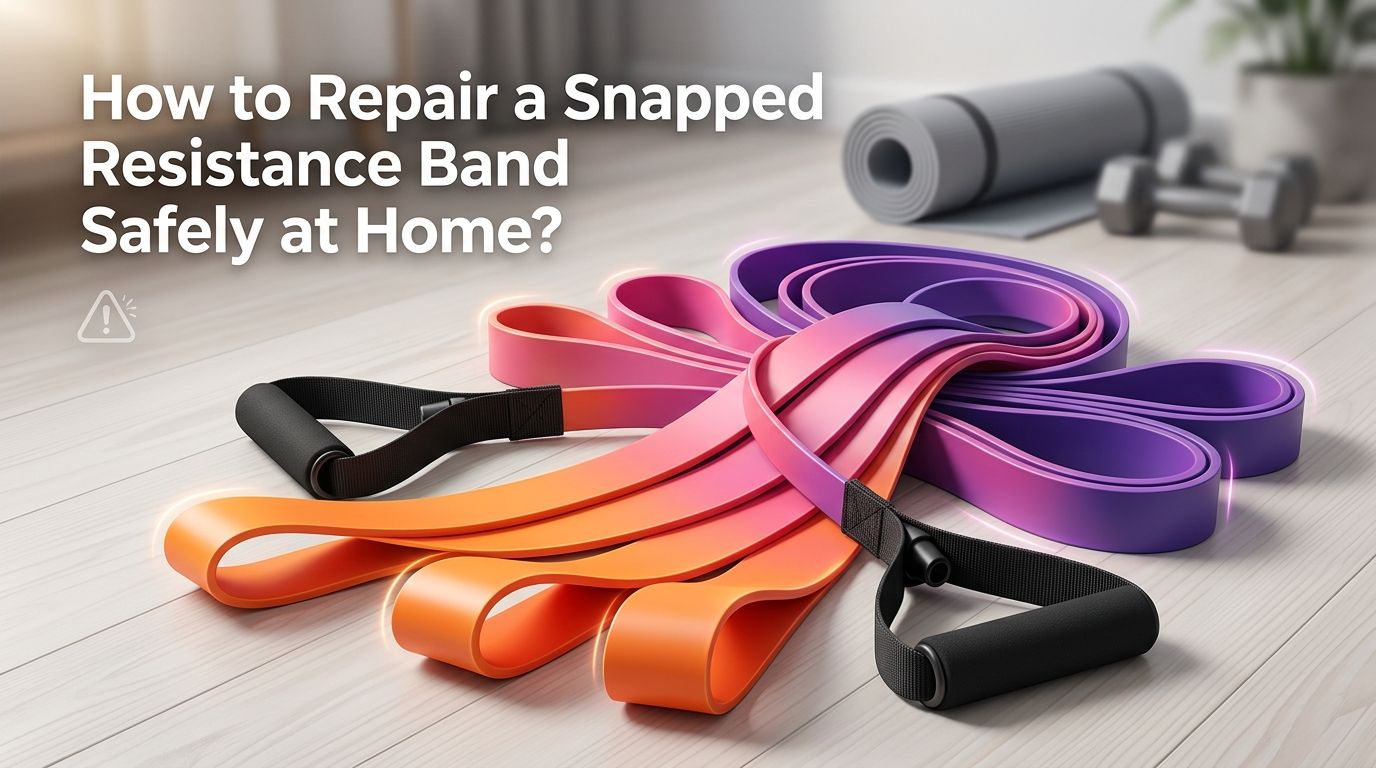
How to Repair a Snapped Resistance Band Safely at Home?
Have you ever been in the middle of a great workout, feeling the burn, and then SNAP? Your resistance band breaks, your momentum dies, and you are left staring at two useless pieces of rubber.
You are not alone. Most home fitness fans experience a broken resistance band at some point. The good news? Many snapped bands can be fixed right at home with basic tools and a bit of patience.
But here is the thing. Not every repair method is safe, and not every broken band should be fixed. A bad repair can lead to the band snapping again mid exercise, and this time it could hit your face or eyes.
In a Nutshell
- Identify the damage type first. A small surface tear, a full snap, and a handle separation each require a different repair approach. Using the wrong method creates a weak point that can fail during your next workout. Always inspect the full length of the band before choosing your fix.
- Hot glue splicing works for complete breaks but has limits. This method can restore about 50% to 70% of the original tension for light to moderate exercises. It is not safe for heavy resistance work or any movement where the band could snap back toward your face.
- Medical tape reinforcement is best for partial tears. Elastic medical tape applied in a cross hatch pattern can restore 70% to 85% of the band’s original strength. This method keeps the band flexible and is the easiest repair for beginners.
- Heat sealing gives the strongest DIY repair. If you have a natural latex band and the right tools, heat sealing can restore up to 85% to 95% of original strength. It requires careful temperature control and patience during the curing process.
- Know when to replace, not repair. Bands with UV damage, multiple previous repairs, or significant elasticity loss should be thrown out. Any band used for face level exercises or heavy loading above 50 pounds must be in perfect condition with no repairs.
- Prevention saves more bands than repairs. Store bands away from sunlight, clean them after use, never stretch them beyond 2.5 times their resting length, and inspect them before every workout. These habits can double or triple the life of your bands.
Why Do Resistance Bands Snap in the First Place
Understanding why your band broke helps you choose the right repair and prevent future breaks. Resistance bands fail for several common reasons, and most of them are avoidable.
Overstretching is the top cause. Every band has a maximum safe stretch length, usually around 2 to 2.5 times its resting size. Going beyond this limit puts extreme stress on the material. Small micro tears form inside the rubber or latex, and these grow until the band fails completely.
UV exposure and heat also destroy bands over time. Sunlight breaks down the molecular structure of latex and rubber. A band stored on a windowsill or in a hot car trunk will degrade much faster than one kept in a cool drawer. You might not see the damage until the band snaps without warning.
Poor anchoring is another frequent cause. Wrapping a band around a rough surface, a sharp door edge, or an uneven post creates friction points. These spots wear through the material faster than the rest of the band. Sweat, oils, and dirt also speed up degradation if you do not clean your bands regularly.
Assess the Damage Before You Start Any Repair
The first step in any resistance band repair is a full inspection. Do not just look at the break point. Check the entire band from end to end for hidden weak spots.
Hold the band up to a light source and stretch it gently to about 50% of its length. Look for discoloration, white streaks, small cracks, or thin spots. These are signs of material fatigue. A band with multiple weak spots is not worth repairing because it will break again at a different location.
Feel the texture of the band with your fingers. A healthy band feels smooth and slightly tacky. A degraded band feels dry, powdery, or overly sticky. Either of these textures means the material has broken down at a chemical level, and no surface repair will restore it.
Check the break itself. A clean snap with smooth edges suggests a single point failure, which is repairable. A jagged, rough break with fraying or crumbling suggests widespread degradation. The second type means the band has reached the end of its useful life.
Tools and Materials You Need for a Safe Repair
Gather everything before you begin. Having the right materials on hand makes each repair method faster and more reliable. Most of these items are common household supplies.
For hot glue splicing, you need a high temperature glue gun, glue sticks, fine sandpaper (220 to 400 grit), isopropyl alcohol, clean cloth, and needle nose pliers. The high temperature glue gun is important because craft temperature glue does not bond well to rubber or latex.
For medical tape reinforcement, you need elastic medical tape, waterproof athletic tape, rubbing alcohol, scissors, and a clean workspace. Make sure the tape is specifically elastic medical tape, not regular bandage tape, because it needs to stretch with the band.
For heat sealing, you need a wood burning tool or soldering iron with a flat tip, clamps, rubber cement, fine sandpaper, and isopropyl alcohol. A thermometer or temperature controlled tool is ideal to maintain the 350 to 400 degree Fahrenheit range needed for proper latex fusion.
Method 1: Hot Glue Splicing for a Complete Snap
This is the most accessible repair for a band that has broken into two pieces. It works best for flat loop bands and tube style bands used in light to moderate exercises.
Start by trimming both broken ends with sharp scissors to create clean, straight cuts. Remove any ragged or frayed material. Then sand about 2 inches of each end with fine sandpaper. This roughens the surface and gives the glue something to grip. Wipe both sanded areas with isopropyl alcohol and let them dry for two minutes.
Apply a generous layer of hot glue to one prepared end. Immediately press the second end on top, overlapping by about 1.5 to 2 inches. Use needle nose pliers to squeeze the overlapped section firmly for 30 to 60 seconds while the glue sets. Then add extra glue along both sides of the joint, building up a thick reinforcement layer.
Let the repair cure for at least 15 to 20 minutes before testing. Test by stretching slowly to 25% capacity, then 50%, then 75%. Watch the splice carefully for any movement or separation.
Pros of this method: Easy to do, requires common tools, works on most band types, and costs almost nothing. Cons of this method: Restores only 50% to 70% of original strength, creates a stiff spot in the band, and is not suitable for heavy resistance work.
Method 2: Medical Tape Reinforcement for Partial Tears
This method works best for bands that have a surface tear, a nick, or a weak spot but have not fully snapped. It is also the safest beginner repair because it adds support without altering the band’s structure.
Clean the damaged area thoroughly with rubbing alcohol and let it dry for two to three minutes. Cut a piece of elastic medical tape about 4 inches longer than the damaged section on each side. Apply the tape while stretching it to about 50% of its capacity. This builds tension into the repair so it supports the band during stretching.
Add two to three layers in a cross hatch pattern. Each layer should run at a different angle and extend slightly beyond the edges of the previous one. Finish by wrapping waterproof athletic tape over the edges of the medical tape to prevent them from peeling up during use.
Allow the adhesive to cure for 30 to 60 minutes before your next workout. This method maintains the band’s flexibility and does not create a hard spot like glue repairs do.
Pros of this method: Maintains band flexibility, easy for beginners, inexpensive, and restores 70% to 85% of strength. Cons of this method: Tape can peel over time with heavy sweat, needs reapplication after several workouts, and does not work for complete breaks.
Method 3: Heat Sealing for Maximum Strength
Heat sealing is the gold standard of DIY resistance band repair. It fuses the latex material at a molecular level, creating a bond that is almost as strong as the original band. However, it requires precision and care.
Trim both band ends cleanly and sand 1 inch back from each cut. Clean with alcohol and align the ends perfectly with no gaps between them. Heat your tool to 350 to 400 degrees Fahrenheit. Press the flat tip firmly against the overlapped band ends for 5 to 15 seconds until the surface becomes glossy and slightly fluid.
Here is the critical part. Do not release pressure while the material cools. Hold firm, even pressure for 30 to 45 seconds as the bond forms. Use clamps if your hands are not steady enough. Once cooled, apply a thin layer of rubber cement along both sides of the joint to seal any tiny gaps.
Let the repair cure for a minimum of 2 to 4 hours. For the strongest result, wait a full 24 hours before using the band. Test with gradual stretching at increasing percentages before your workout.
Pros of this method: Restores 85% to 95% of original strength, creates a permanent bond, and works well on natural latex bands. Cons of this method: Requires specific tools, risk of burns, takes longer to complete, and only works on natural latex (not fabric or synthetic bands).
How to Reattach a Separated Handle or Clip
Sometimes the band itself is fine, but the handle pulls free or a clip detaches. This type of repair is often simpler than fixing a break in the band material.
For loop style attachments, cut the damaged end of the band cleanly. Fold the new end back about 1 inch to create a doubled section. Apply industrial contact cement to both surfaces of the fold. Press them together firmly and clamp for 2 to 4 hours. You can also use a small metal crimp clamp for added security.
For glued handle connections, scrape away all old adhesive from both the band and the handle. Sand both surfaces lightly and clean with alcohol. Apply two part epoxy to both surfaces and press together. Clamp for a full 24 hours. Wrap waterproof athletic tape around the connection point before the epoxy fully cures to add a secondary layer of support.
Check the connection by pulling firmly before adding any body weight or resistance. The bond should feel solid with no movement or give at the attachment point.
Tying a Snapped Band: A Quick but Limited Fix
If you do not have glue, tape, or tools available, tying the broken ends together is a fast temporary solution. This gets you through a workout in a pinch but is not a long term fix.
Use a simple overhand knot by overlapping the two broken ends by about 3 to 4 inches and tying them together tightly. A double overhand knot is more secure. Pull the knot as tight as possible because any slack will cause the band to slip during stretching.
Be aware that a knot creates a concentrated stress point. The band material at the knot bears much more force than the rest of the band. This means the band is likely to break again at or near the knot. The effective length of your band also decreases by several inches, which changes the resistance level.
Pros of this method: Requires no tools or materials, takes less than a minute, and works anywhere. Cons of this method: Significantly weakens the band, changes the resistance level, creates a hard lump that can be uncomfortable, and is only a temporary fix.
Safety Rules for Using a Repaired Resistance Band
A repaired band is not the same as a new band. You must adjust how you use it to stay safe. Follow these rules every time you use a repaired band.
Never aim a repaired band at your face or eyes. Avoid exercises like face pulls, band pull aparts at face height, or any overhead movement where a failure would send the band toward your head. Eye injuries from snapped bands are serious, and repaired bands carry higher failure risk.
Start every session with a visual and tactile inspection of the repair. Look for any separation, peeling, cracking, or deformation at the repair site. Stretch the band slowly to 50% before beginning your workout. If anything looks or feels different from your last session, stop using the band.
Reduce your working load by at least 25% to 30% compared to what you used before the break. A repaired band cannot handle the same stress as a new one. Use it for warm ups, mobility work, and light accessory exercises rather than heavy primary movements.
When You Should Skip the Repair and Replace the Band
Some situations call for a new band, no matter how good your repair skills are. Knowing these limits protects you from injury.
Replace the band if it shows signs of UV damage. This includes yellowing, brown spots, a chalky or powdery surface, or a sticky texture that was not there before. UV degradation affects the entire band, not just the visible spots. A surface repair cannot fix internal material breakdown.
Replace the band if it has been repaired more than twice. Each repair adds a stress point and reduces the overall strength of the band. After two repairs, the cumulative weakness makes the band unreliable and unsafe for any exercise.
Replace bands used for heavy resistance work (above 40 to 50 pounds of tension) at the first sign of any damage. Also replace any band you use for assisted pull ups, as a failure during this exercise can cause a serious fall. The cost of a new band is always less than the cost of an injury.
How to Prevent Your Resistance Bands from Breaking Again
The best repair is the one you never have to make. A few simple habits will keep your bands healthy much longer.
Store your bands in a cool, dry drawer or bag away from windows and heat sources. A temperature range of 60 to 75 degrees Fahrenheit is ideal. Never leave bands in your car, garage, or outdoor gym bag for extended periods. Roll them loosely rather than folding or stretching them during storage.
Clean your bands after every workout with a damp cloth and mild soap. Sweat contains salts and oils that eat away at rubber and latex over time. A quick wipe down takes 30 seconds and can add months to a band’s life. Let bands air dry completely before storing them.
Inspect your bands before every use. Run your fingers along the entire length and look for nicks, thin spots, or surface cracks. Catching a weak spot early means you can reinforce it with tape before it becomes a full break. This one habit alone prevents most resistance band failures.
Frequently Asked Questions
Can I use super glue to fix a snapped resistance band?
Super glue is not a good choice for resistance band repair. It creates a very hard, rigid bond that does not flex with the band. When you stretch the band, the super glue joint resists the movement and creates extreme stress at the edges of the repair. This usually causes the band to tear right next to the glued area. Hot glue, rubber cement, or contact cement are better options because they maintain some flexibility after curing.
How long does a resistance band repair usually last?
The lifespan of a repair depends on the method used and how you use the band. A hot glue splice typically lasts for 2 to 4 weeks of regular light use. Medical tape reinforcement can hold for 1 to 3 weeks before needing reapplication. Heat sealed repairs on latex bands can last several months with proper care. All repairs last longer if you reduce the working load and avoid overstretching.
Is it safe to use a repaired resistance band for pull ups?
No. Assisted pull ups place your full body weight on the band, and a failure during this exercise can cause a sudden fall. The forces involved are too high for any DIY repair to handle safely. Always use a brand new, fully intact band for pull up assistance, overhead presses, and any exercise where the band supports significant weight.
Can I repair a fabric resistance band the same way?
Fabric bands require different repair methods than latex or rubber bands. Hot glue and heat sealing do not work on fabric. Instead, you can sew a fabric band using a strong needle and heavy thread. Reinforce the stitched area with fabric glue for extra hold. However, fabric band repairs tend to be less reliable than latex repairs because the stitching creates small holes that can become new tear points.
How can I tell if my resistance band is too old to repair?
Check for these signs: the band has a dry, chalky, or powdery texture; it has turned yellow or brown; it feels unusually sticky; it has visible surface cracks even when not stretched; or it has lost significant elasticity and no longer returns to its original length after stretching. Any of these signs mean the material has degraded beyond what a surface repair can fix, and the band should be replaced.

Hi, I’m Sarah Hill — the founder and voice behind Heavy Lift Vault. I’m passionate about fitness, strength training, and health technology. I spend my time researching, testing, and reviewing workout equipment and health devices so you don’t have to guess. My goal is to deliver honest, detailed, and trustworthy reviews that help you invest wisely in your fitness journey.