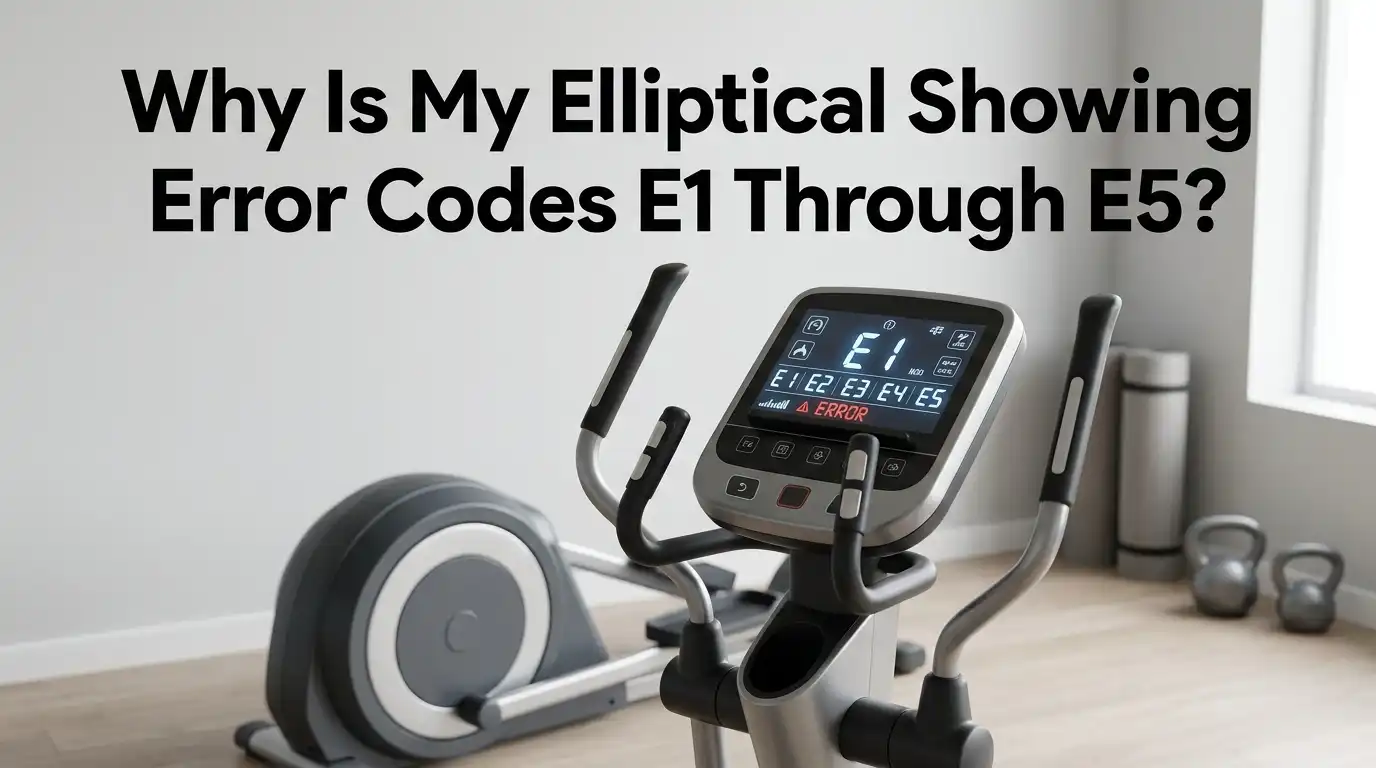
Why Is My Elliptical Showing Error Codes E1 Through E5?
You just stepped onto your elliptical, ready for a solid workout. But instead of your usual display lighting up with stats, a strange error code blinks at you. E1. Or maybe E3.
Perhaps all five codes have taken turns ruining your mornings this week. You are not alone. Thousands of elliptical owners face this exact frustration every day.
These error codes are your machine’s way of telling you something is wrong, but the problem is that most manuals do a terrible job of explaining what they actually mean.
In a Nutshell
- E1 errors almost always relate to speed sensor or power communication failures. A loose cable between the console and control board is the most common cause. You can often fix this by unplugging the machine, checking the data cable, and reconnecting it firmly.
- E2 errors typically signal sensor misalignment or erratic speed readings. The speed and cadence sensors near the flywheel may have shifted out of position. Cleaning the sensor area and adjusting the gap between the sensor and the magnet usually clears this code.
- E3 errors point to display module or communication malfunctions. The console may flicker, go dim, or freeze entirely. Checking the wiring behind the console panel and reseating connectors is the first step to resolve this issue.
- E4 errors generally indicate a motor or resistance system overload. The resistance motor may be overheating or blocked by debris. Letting the machine cool down and clearing any obstructions around the motor area often fixes the problem.
- E5 errors usually mean the control board detected a power surge or internal fault. This is the most serious of the five codes and may require professional inspection if basic troubleshooting does not resolve it.
- A simple power reset clears many temporary error codes. Unplug your elliptical for 60 seconds, then plug it back in. This basic step resolves a surprising number of errors caused by minor software glitches.
What Do Elliptical Error Codes Actually Mean
Error codes are diagnostic signals that your elliptical’s control board sends to the console display. Think of them as the machine’s own language for reporting problems. Each code corresponds to a specific system or component inside the elliptical.
The codes E1 through E5 are among the most common across major brands. While the exact meaning can vary slightly between manufacturers, the general categories remain consistent. E1 relates to speed or communication issues. E2 involves sensor problems. E3 connects to the display. E4 flags motor trouble. E5 warns about the control board itself.
Your owner’s manual should list the exact definitions for your specific model. If you have lost your manual, most manufacturers post digital copies on their websites. Always cross reference the general guidance in this article with your machine’s specific documentation.
E1 Error Code: Speed Sensor and Communication Failures
The E1 error is the most frequently reported code across elliptical brands. It generally means the console cannot communicate properly with the control board or the speed sensor is not sending data.
A loose or disconnected data cable is the primary cause. This cable runs between the console at the top of the machine and the control board inside the base. Vibrations from regular use can slowly loosen the connection over time.
To fix an E1 error, start by powering off and unplugging the elliptical. Remove the console cover carefully using a screwdriver. Locate the data cable and check both ends for a secure connection. Press each connector firmly into its socket. Reassemble the cover, plug the machine back in, and test it.
If the cable looks damaged or frayed, you will need a replacement cable specific to your model. A faulty speed sensor near the flywheel can also trigger E1 codes. Check the sensor for dirt buildup or physical damage.
Pros of DIY repair: Low cost, quick turnaround, no waiting for a technician.
Cons of DIY repair: Risk of further damage if cables are handled roughly, may void warranty on newer machines.
E2 Error Code: Sensor Misalignment and Erratic Readings
An E2 error typically means the speed or cadence sensors have shifted out of their correct position. These sensors sit near the flywheel and detect how fast the pedals are moving. Even a small gap change can cause erratic readings or trigger the error.
Dust and debris buildup around the sensor area is another common cause. Sweat, lint, and household dust collect near the flywheel over months of use. This buildup interferes with the sensor’s ability to detect the magnetic signal accurately.
To fix an E2 error, unplug the machine and locate the sensors near the flywheel. They are usually small rectangular or cylindrical components mounted close to a magnetic disc. Clean the area with a dry, lint free cloth. Check the gap between the sensor and the magnet. Most manufacturers recommend a gap of 3 to 5 millimeters.
If the sensor has physically moved, loosen its mounting screw, reposition it to the correct gap, and tighten it back down. Test the machine at low speed first to confirm the error has cleared.
Pros of sensor adjustment: Simple process with basic tools, highly effective for this error.
Cons of sensor adjustment: Incorrect gap setting can cause new errors, sensors may need full replacement if damaged internally.
E3 Error Code: Display Module and Console Malfunctions
The E3 code signals a problem with the display module or the wiring that connects it to the control board. You may notice the screen flickering, going blank, showing garbled numbers, or freezing completely before this code appears.
Loose wiring connections behind the console panel cause most E3 errors. The ribbon cable or connector that feeds data to the display screen can work itself loose over time. Humidity and temperature changes in your workout space can also affect these connections.
To troubleshoot, power off the machine and remove the console’s back panel. Locate the display ribbon cable or connector. Gently disconnect it, inspect both the cable and the socket for corrosion or damage, then firmly reconnect. If you see green or white residue on the connectors, clean them with isopropyl alcohol on a cotton swab.
If the display module itself is cracked or visibly damaged, you will need a replacement part from the manufacturer. A failing display module cannot be repaired at home and must be swapped entirely.
Pros of connector maintenance: Often resolves the problem immediately, costs nothing.
Cons of connector maintenance: Display modules can be expensive to replace, and wrong handling may crack ribbon cables.
E4 Error Code: Motor Overload and Resistance System Issues
An E4 error points to a problem with the resistance motor, the incline system, or the drive mechanism. This code appears when the motor draws too much current, overheats, or cannot complete the resistance adjustment the console requested.
Debris blocking the motor’s cooling fan is a surprisingly common trigger. Dust bunnies, pet hair, and lint can accumulate inside the motor housing and restrict airflow. The motor overheats because it cannot cool itself, which triggers the E4 safety code.
Start by unplugging the machine and letting it cool for at least 30 minutes. Open the motor housing cover and remove any visible debris with compressed air or a soft brush. Check the resistance motor wires for secure connections.
If the motor makes grinding or clicking sounds, the internal gears may be worn. This requires motor replacement, which is best handled by a technician. Also inspect the drive belt for wear or slipping, as a failing belt puts extra strain on the motor.
Pros of cleaning the motor area: Simple, effective, and prevents future overheating.
Cons of cleaning the motor area: Deep motor problems require professional repair, replacement motors can be costly.
E5 Error Code: Control Board Power Surges and Internal Faults
The E5 error is the most serious code in this range. It means the control board has detected a power irregularity, internal circuit damage, or a significant electrical fault. Power surges from your home’s electrical system are a leading cause.
Lightning strikes, fluctuating voltage, and plugging the elliptical into an overloaded circuit can all damage the control board. Burnt or discolored areas on the circuit board are a clear sign of surge damage. Moisture exposure from a humid basement or garage can also corrode sensitive components.
Unplug the machine and open the base panel to inspect the control board. Look for any black marks, melted components, or a burnt smell. If you find visible damage, the board needs professional repair or replacement.
If the board looks clean, try a full power reset. Unplug the machine for five minutes, then plug it into a different outlet. Using a surge protector is strongly recommended to prevent future E5 errors. Never plug an elliptical into a power strip without surge protection.
Pros of surge protector use: Inexpensive prevention against the most expensive error.
Cons of control board replacement: Can cost $100 to $400 depending on the model, often requires professional installation.
How to Perform a Basic Power Reset
A power reset is the simplest and most effective first step for any error code. This process clears temporary software glitches and resets the console’s memory. Many error codes that appear after a power fluctuation or unusual shutdown will disappear after a proper reset.
Unplug the elliptical from the wall outlet completely. Do not just flip the power switch. Wait at least 60 full seconds. Some technicians recommend waiting up to five minutes for a complete capacitor discharge.
Plug the machine back in and turn it on. Watch the console during startup for any returning error codes. If the code reappears immediately, the problem is hardware related and needs further investigation. If the code clears, use the machine at low intensity for a few minutes to confirm the fix held.
Keep a log of when error codes appear. Patterns can help identify the root cause. For example, errors that show up only after 20 minutes of use may indicate overheating.
When to Check Your Owner’s Manual First
While this guide covers the general meaning of error codes E1 through E5, your specific elliptical model may define these codes differently. Some brands use E1 for low voltage detection instead of speed sensor failure. Others use E4 for communication errors rather than motor issues.
Your owner’s manual is the most reliable source for your machine. It will list every error code, its exact meaning, and the manufacturer’s recommended fix. Many manuals also include wiring diagrams and sensor location guides that make troubleshooting much easier.
If you cannot find your physical manual, visit the manufacturer’s website and search for your model number. Most companies offer free PDF downloads of their manuals. You can also call the manufacturer’s customer support line for guidance specific to your machine.
Do not assume that a general fix applies to your model without checking. Applying the wrong solution could create new problems or void your warranty.
Tools You Need for Basic Elliptical Troubleshooting
You do not need a garage full of specialized equipment to fix most elliptical error codes. A small set of common tools covers the majority of repairs discussed in this article.
A Phillips head screwdriver and a flat head screwdriver will handle most console and panel covers. An Allen wrench set is useful for bolts on the frame and motor housing. A multimeter is essential if you want to test electrical continuity in wires, sensors, or the control board. You can find a basic digital multimeter at any hardware store.
Compressed air in a can cleans dust from tight spaces around sensors and circuit boards. Isopropyl alcohol and cotton swabs clean corroded connectors safely. A lint free cloth handles general cleaning.
Keep your tools organized in a small kit near your elliptical. Having everything ready means you can troubleshoot an error code in minutes instead of searching the house for the right screwdriver.
Common Mistakes That Trigger Error Codes
Many error codes are preventable. Understanding what causes them helps you avoid the problem in the first place. Here are some frequent mistakes elliptical owners make that lead directly to error codes appearing on the console.
Plugging the elliptical into a power strip without surge protection invites E5 errors. Skipping regular cleaning allows dust to build up on sensors, causing E1 and E2 codes. Ignoring small squeaks or grinding noises can lead to motor strain and eventual E4 errors.
Placing the elliptical in a damp basement or garage exposes the electronics to moisture. This corrodes connectors and circuit board traces over time. Running the machine at maximum resistance for extended periods without breaks can overheat the motor.
Moving the elliptical without disconnecting cables first can pull connectors loose inside the console. This single action triggers E1 and E3 errors more often than most people realize.
When to Call a Professional Technician
Some problems go beyond what a screwdriver and a YouTube video can fix. Knowing when to stop and call a professional protects both you and your machine.
Call a technician if you see visible burn marks or melted components on the control board. Electrical repairs involving the main circuit board carry a risk of shock and further damage. If the same error code returns after you have tried every troubleshooting step in this guide, a deeper issue exists that requires diagnostic equipment.
Motor replacement, control board soldering, and wiring harness repairs all fall into professional territory. A qualified fitness equipment technician has the tools and training to diagnose problems accurately.
Getting a repair estimate before approving work is always a smart move. Compare the repair cost to the price of a replacement part or even a new machine to make the best decision for your budget.
Preventive Steps to Avoid Future Error Codes
Prevention is cheaper and easier than repair. A few simple habits keep error codes from appearing on your console in the first place.
Wipe down the machine after every workout. Sweat is corrosive and can damage sensors and electronic contacts over time. Clean the flywheel area and sensor zone with a dry cloth at least once a month. Apply manufacturer approved lubricant to rails and joints every three to six months.
Use a surge protector for your elliptical’s power supply. Check all visible cable connections quarterly by gently pressing each connector to confirm it is secure. Keep the room ventilated and dry to protect the control board from humidity damage.
Schedule a professional inspection once every 12 to 24 months. A technician can catch worn sensors, fraying cables, and early motor problems before they trigger error codes. This small investment extends the life of your machine significantly.
Understanding Your Warranty Coverage
Before you open any panels or replace any parts, check whether your elliptical is still under warranty. Many manufacturers offer one to three years of coverage on electronics and up to five years on the frame.
DIY repairs on a machine under warranty can void that coverage. Contact the manufacturer first to report the error code. They may authorize a free repair, send replacement parts at no cost, or dispatch a certified technician to your home.
Keep your purchase receipt and warranty registration details in a safe place. If you bought the elliptical used, check whether the warranty transfers to second owners. Some brands allow it while others do not.
Even if the warranty has expired, the manufacturer’s support team can still help identify the correct replacement parts for your specific model. This avoids the risk of ordering incompatible components.
Frequently Asked Questions
Can I still use my elliptical if an error code is showing?
It depends on the code. E1 and E2 errors may allow limited use, but the machine will not track your workout accurately. E4 and E5 errors indicate motor or electrical problems, and using the machine could cause further damage or create a safety risk. Power off and troubleshoot before resuming workouts.
How much does it cost to repair an elliptical control board?
Control board repairs typically range from $100 to $400 depending on the brand and the extent of the damage. Some repair services fix the existing board rather than replacing it, which can save money. Always get an estimate before approving any work.
Why does my elliptical show an error code only after warming up?
This pattern usually points to an overheating issue. The motor or control board functions normally at first but triggers a safety code once internal temperatures rise too high. Check for blocked vents, dirty cooling fans, or a failing motor that draws excessive current.
Do all elliptical brands use the same error codes?
No. Error code definitions vary between manufacturers and sometimes between models within the same brand. E1 on one machine might mean something completely different on another. Always refer to your specific owner’s manual for accurate information.
How often should I clean the sensors on my elliptical?
Clean the speed and cadence sensors at least once a month if you use the machine regularly. If you have pets or your elliptical sits in a dusty environment, clean the sensors every two weeks. A dry lint free cloth is all you need for this quick maintenance task.
Will a surge protector really prevent error codes?
A surge protector specifically prevents E5 type errors caused by power surges and voltage spikes. It will not prevent errors caused by sensor misalignment, loose cables, or motor wear. However, it is one of the cheapest and most effective ways to protect the most expensive component in your elliptical, the control board.

Hi, I’m Sarah Hill — the founder and voice behind Heavy Lift Vault. I’m passionate about fitness, strength training, and health technology. I spend my time researching, testing, and reviewing workout equipment and health devices so you don’t have to guess. My goal is to deliver honest, detailed, and trustworthy reviews that help you invest wisely in your fitness journey.